The Silence of the Backyard Oasis
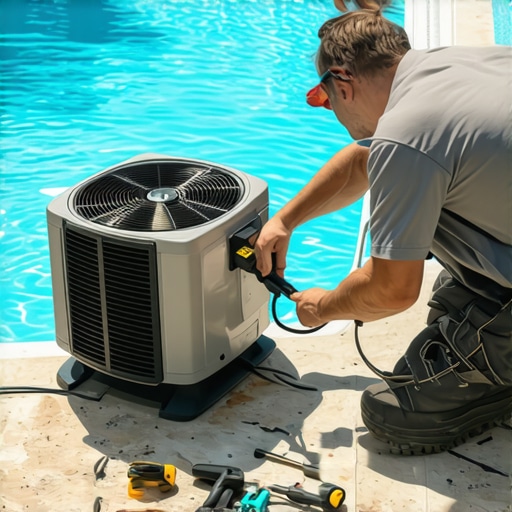
I’ve spent three decades sweating through my uniform, mostly in attics where the heat index hits triple digits, but nothing ruins a customer’s mood faster than the silence of a dead pool heater on a June morning. You see, most people treat their pool heater like a toaster—they expect it to just work. But as an Airflow Architect who’s fixed everything from a complex restaurant kitchen exhaust repair to a delicate wood burning stove installation, I can tell you: thermodynamics doesn’t take a vacation. My old mentor, a guy who could smell a gas leak from a block away, used to scream at me, ‘You can’t heat what you can’t touch!’ This is the absolute law of the trade. If the water isn’t touching the heat exchanger with the right velocity, or if the flame isn’t touching the copper fins properly, you’re just burning money. Airflow and water flow are two sides of the same coin. Whether I’m performing manual J calculations for a warehouse or checking the manifold pressure on a pool heater, the physics remains the same.
“The most expensive equipment in the world cannot overcome a bad duct system.” – Industry Axiom
In our industry, we see a lot of ‘Sales Techs’—kids in clean shirts who couldn’t tell a capacitor from a contactor—trying to sell a $10,000 new unit when the fix is just a bit of elbow grease and technical know-how. This guide is for those who want the raw truth. If you are in a Northern climate, where the winter frost tries to crack every pipe and the summer is a precious window, you need your gear ready. We’re going to walk through the forensic diagnosis of a pool heater, using the same logic I apply to furnace repair services. When the ‘Juice’ (gas) meets the spark, everything has to be perfect.
Fix 1: The Heat Exchanger Decarbonization (The Soot Struggle)
The heat exchanger is the heart of the machine. It’s where the thermal transfer happens. In pool heaters, we often see a massive buildup of soot or lime scale. If you’ve ever looked at a neglected wall furnace installation, you know what I’m talking about. Soot acts as an insulator. When the burners fire up, that heat should be jumping into the water. Instead, it’s bouncing off the soot and going straight up the stack. This is sensible heat being wasted because it can’t become latent energy in your pool water. I’ve seen exchangers so choked that they started ‘flame rolling’ out the front, melting the thermostat wiring upgrades the homeowner just paid for. You need to pull the burner tray and use a soft brush. Don’t go at it like a Tin Knocker with a hammer; be gentle. If the fins are clogged, your efficiency drops to zero. This is very similar to why we recommend expert tips for efficiency in home AC units. Cleanliness is not about aesthetics; it’s about heat transfer physics.
Fix 2: The Pressure Switch Paradox
Pool heaters are safety-obsessed. The pressure switch is the sentry. It ensures that the ‘Sparky’ (electrician) did his job and the pump is actually moving water before the fire starts. If the switch doesn’t sense water pressure, it won’t let the gas valve open. I’ve been called out to jobs where the homeowner was quoted a whole new control board, but the real issue was a handful of leaves in the filter basket reducing the flow. It’s the same logic we use for MERV filter upgrades in a home system—if you restrict the flow, the system chokes. Check your internal bypass valve. If that spring is weak, the water bypasses the exchanger, the pressure switch doesn’t ‘make,’ and you’re left with a cold pool and a frustrated family. Always verify the flow rate against the manufacturer’s specs before you start replacing expensive electronics.
“Design air flow and water flow shall be determined in accordance with industry recognized procedures.” – ACCA Manual J Standards
Fix 3: Orifice Obstructions and the Spider Problem
In my thirty years, I’ve found that spiders love the smell of mercaptan—the stuff they add to gas to make it smell like rotten eggs. They crawl into the burner orifices and spin webs. This creates a partial blockage that messes with the Venturi effect. Instead of a clean blue flame, you get a lazy yellow flame that creates carbon monoxide and soot. This is a common service call for furnace tune-up services too. I once spent four hours on a warehouse heating solutions project only to find a single spider web in the primary air shutter. For your pool heater, you need to clear those orifices with a small wire or compressed air. Never drill them out; you’ll ruin the gas-to-air ratio and end up with a dangerous situation. We’re looking for a crisp, blue cone of flame that stays on the burner. If it’s lifting, your gas pressure is too high; if it’s yellow, you’re starving for air.
Fix 4: The Control Loop and Thermostat Integrity
Modern heaters have gone digital, which is a nightmare in a high-moisture environment. Corroded terminals are the silent killer of 2026 summers. I always check the thermostat wiring upgrades first. If you have high resistance at a connection, the board will throw a phantom error code. It’s like a two-stage furnace installation—if the communication between the thermostat and the gas valve is interrupted by a bad ‘Pookie’ (mastic) seal or moisture, the system won’t ramp up to high stage. Use a multimeter to check for 24V at the gas valve. If the board says ‘Heat’ but the valve is dead, check your limits and sensors. Often, it’s just a corroded spade connector. A little bit of sandpaper and some dielectric grease can save you the $800 a Sales Tech would charge for a new board. For more complex control issues, you might need to look at mini-split troubleshooting logic, as the electronic components are quite similar.
The Final Word on Maintenance
Don’t wait until the Fourth of July to find out your heater is a paperweight. Regular checks are the only way to avoid the emergency call-out fee. Whether it’s a heat pump maintenance routine or a pool heater check, the goal is the same: longevity through physics. Keep your chemistry balanced—acidic water will eat a copper heat exchanger in a single season, turning your ‘Beer can cold’ suction line dreams into a copper-leached nightmare. Understanding the relationship between water chemistry and metallurgy is just as important as knowing how to wire a contactor. Stay vigilant, keep it clean, and respect the airflow.