
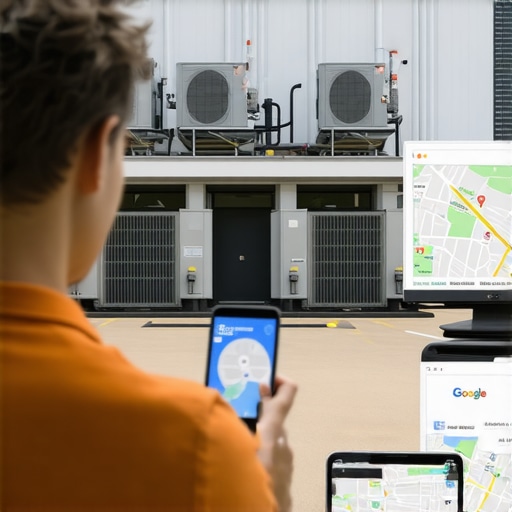
Why Property Managers Can’t Find Your Commercial HVAC Listing on Google Maps
Imagine this: A facility manager at a 200,000-square-foot distribution center is standing in a mechanical room ankle-deep in water. A primary chiller has failed, and the internal temperature is rising, threatening millions of dollars in temperature-sensitive inventory. They pull out their phone and search “commercial HVAC repair near me” or “chiller service [City Name].”
Your shop is five miles away. You have ten technicians, a fleet of fully stocked vans, and twenty years of experience with RTUs and heavy-tonnage systems. But when that manager scrolls through the Google Maps Local 3-Pack, your business is nowhere to be found. Instead, they see residential “mom-and-pop” shops that wouldn’t know a cooling tower from a residential condenser.
This isn’t just a minor marketing glitch; it is a catastrophic leak in your revenue bucket. In the world of high-intent search, visibility isn’t a matter of luck. It is a calculated result of the Proximity, Relevance, and Prominence algorithm. If you aren’t appearing, it’s because Google doesn’t trust your profile to satisfy a commercial lead. As a specialist in google business profile seo, I’ve seen this “invisibility” destroy even the most competent mechanical contractors. Let’s break down why you’re hidden and how to claim the highest-intent real estate in search.
1. The “Service Area” Trap: Why Your Radius is Killing Your Authority
Most commercial HVAC owners believe that more is better. They set their Service Area Business (SAB) settings to cover a 100-mile radius, thinking it will help them catch property managers in neighboring counties. In reality, this broad stroke often dilutes your local authority to the point of irrelevance.
Google’s algorithm is designed to provide the most localized, relevant result. When you tell Google you serve “the entire tri-state area” without a physical, verified office presence in those specific zones, the algorithm perceives you as a “jack of all trades, master of nowhere.” For an HVAC business, google business profile optimization involves defining realistic, data-backed service areas rather than aspirational ones.
If you are a Service Area Business (meaning you go to the client rather than they come to you), you must be surgical. Overlapping service areas or radiuses that extend beyond a 2-hour drive often trigger “proximity filters” that favor a competitor with a tighter, more focused geographic signal. If your multi-city strategy is actually hurting your local search rank, it’s because you’ve failed to establish a “home base” that Google views as authoritative.
Internal Link: Why Your Multi-City Strategy Is Actually Hurting Your Local Search Rank
2. Category Confusion: Residential vs. Commercial Signals
One of the most common reasons commercial HVAC companies fail to rank google business profile listings for high-value contracts is “Category Dilution.” Many shops simply select “HVAC Contractor” as their primary category and call it a day. While technically accurate, it’s not specific enough to attract a property manager looking for a specialized mechanical contractor.
Google uses categories as the primary “Relevance” signal. To dominate the commercial space, you must audit your secondary categories. Are you listed as a “Mechanical Contractor”? Do you have “Commercial Refrigeration” selected? Are you identified as an “Air Conditioning Repair Service”?
Property managers use specific terminology. If your profile is cluttered with residential-leaning signals, Google’s AI will categorize you alongside the residential furnace repair companies. To rank higher on google maps for commercial queries, your category stack must mirror the sophisticated needs of a facility manager. This means prioritizing “Mechanical Contractor” or “Heating Contractor” if those align more closely with your high-ticket commercial projects.
Internal Link: How to Outrank Local Competitors by Choosing the Right Google Business Categories
3. The Authority Gap: Why 5-Star Reviews Aren’t Enough
A common frustration I hear is: “Chandan, I have 50 five-star reviews and my competitor has 10, yet they are outranking me. Why?” The answer lies in the content and context of those reviews. For commercial HVAC, a review from “Mrs. Smith” about her thermostat installation carries zero weight with a property manager looking for a cooling tower overhaul.
Google’s Natural Language Processing (NLP) reads your reviews to understand your “Prominence.” If your reviews frequently mention “RTU maintenance,” “chiller repair,” “VAV box,” or “commercial contract,” Google associates your business with those high-intent keywords. To bridge the authority gap, you need a review strategy that encourages commercial clients to use industry-specific terminology. Using local seo software can help you track which keywords are appearing in your reviews and how they correlate to your Map Pack position.
Property managers look for scale and reliability. A profile that signals commercial expertise through its review corpus will always outrank a residential-heavy profile, even if the latter has a higher total review count. You are no longer just fighting for a star rating; you are fighting for topical relevance.
Internal Link: Why a 5-Star Rating Isn’t Enough to Rank No. 1 on Google Maps Anymore
4. Technical Red Flags: P.O. Boxes and NAP Inconsistency
Google is obsessed with trust. If your business data is inconsistent, Google will hedge its bets by not showing you at all. The most frequent “death sentence” for a commercial HVAC listing is the use of a P.O. Box, UPS Store address, or a virtual office. Google’s guidelines are clear: you must have a physical location where you conduct business or be a verified SAB at a residential address (which is then hidden).
Inconsistent Name, Address, and Phone (NAP) data across the web – on Yelp, Yellow Pages, and your own website – creates “fuzziness.” If your website says “Chilly Pro HVAC LLC” but your Google Business Profile says “Chilly Pro Commercial Air Conditioning,” the algorithm sees two different entities. Proper google business profile seo requires absolute 1:1 parity across all digital touchpoints. If your business details are mismatched, you are essentially telling Google that you aren’t a legitimate, stable enterprise.
Internal Link: Why Mismatched Business Details are Keeping Your HVAC Shop Off the Map
5. Proximity vs. Prominence: Winning the 2026 Algorithm
As we look toward the 2026 landscape of local search, the “Proximity” factor is being balanced by an increased focus on “Prominence.” Google understands that for specialized services like commercial HVAC, a user is willing to look further away for a qualified expert. This is where a professional google maps ranking service becomes essential.
Prominence is determined by how well-known your business is offline and across the broader web. This includes mentions in local news, backlinks from industry associations (like ACCA or ASHRAE), and your overall digital footprint. If you want to outrank the guy down the street, you have to prove to Google that you are a “big deal” in the mechanical contracting world. This shift in the 2026 algorithm means that local SEO is no longer just about your GBP; it’s about your entire brand’s authority.
For commercial shops, this means your website must have dedicated pages for “Chiller Repair,” “Boiler Maintenance,” and “Commercial Preventive Maintenance.” These pages act as “hooks” that feed the Map Pack algorithm, proving your relevance for those specific, high-value searches.
Internal Link: Why Local SEO Trends in 2026 Are Shifting How Facility Managers Find Contractors
6. The Commercial Content Strategy: Visual Proof for Facility Managers
Property managers are risk-averse. They want to see that you’ve handled projects of their scale before they even pick up the phone. This is where your GBP Posts and Photos become your most powerful sales tool. If your profile is filled with stock photos of happy families or generic thermostats, you are failing the “vibe check” for a commercial lead.
You need photos of:
- Cranes lifting RTUs onto warehouse roofs.
- Detailed shots of complex piping and manifold systems.
- Your team in safety gear (PPE) on a job site.
- The interior of your warehouse showing your inventory of parts.
Regularly posting updates about large-scale projects signals to Google that your business is active and relevant. It’s not just about “content”; it’s about “contextual proof.” When you show Google (and the property manager) that you are consistently working on commercial sites, your visibility for those specific search terms will skyrocket.
Internal Link: 7 Photos your HVAC business needs on Google to stop customers from scrolling past
7. Diagnostic Tools: How to See What Google Sees
You cannot fix what you cannot measure. Most HVAC owners check their rankings by searching from their office. This is a mistake. Because of the proximity factor, your results are biased based on your physical location. To get a true picture of your visibility across the city, you must use a google maps rank tracker.
Tools like SEO Viper Tools allow you to see a grid-based view of your rankings. You might be #1 at your office, but #15 just three blocks away. This “Heat Map” approach identifies exactly where your “dead zones” are. Once you identify these gaps, you can tailor your local SEO strategy – through geo-targeted landing pages and localized citations – to expand your “green zone” and capture more commercial leads from across your entire service territory.
Internal Link: 4 Mapping Tools That Prove Where Your Commercial HVAC Leads are Searching From
Conclusion: Claim Your Spot in the Local 3-Pack
Ranking for commercial HVAC isn’t about “tricking” Google; it’s about providing the algorithm with the clear, authoritative signals it needs to trust your business. From refining your service area and categories to building a review profile that speaks the language of facility managers, every step is a brick in your digital foundation.
If you’re tired of losing five-figure contracts to inferior competitors simply because they have a better Map Pack presence, it’s time to act. Audit your profile, clean up your technical data, and start showing Google that you are the premier mechanical contractor in your region. For a professional deep-dive into your current standing, reach out for a comprehensive local SEO audit.
Internal Link: Contact Chilly Pro HVAC for a Local SEO Audit