You can tell a poorly designed warehouse by the sound it makes when the bay doors open. It’s a low, guttering whistle that signals your expensive BTUs are screaming out into the winter night while your employees shiver in three layers of Carhartt. I’ve spent thirty years on the business end of a manifold gauge, and if there is one thing that boils my blood, it’s seeing a facility manager throw money at bigger furnaces when their real problem is fluid dynamics. You don’t have a heating problem; you have a pressure and infiltration problem. In the HVAC trade, we call the guys who just swap parts ‘parts changers’ or ‘Sales Techs.’ They’ll sell you a 200,000 BTU unit heater for a dock that’s basically a wind tunnel. But me? I’m an Airflow Architect. I look at the building as a living, breathing thermodynamic system.
“The most expensive equipment in the world cannot overcome a bad duct system or an unsealed building envelope.” – Industry Axiom
My old mentor, a man who could sniff out a cracked heat exchanger from the parking lot, used to scream at me, ‘You can’t heat what you can’t touch!’ He was right. If the air is moving at 15 miles per hour through a loading dock, your radiant heat is useless. You’re trying to heat the entire county instead of your floor space. This is the ‘Physics Lesson’ of the trade. If you don’t control the path of the air, you’re just paying the utility company for the privilege of being cold. We start every real fix with manual J calculations tailored for high-volume spaces. Without the math, you’re just guessing, and guessing is for the ‘Tin Knockers’ who don’t own a calculator.
The Loading Dock Draft: A Case of Negative Pressure
When those massive overhead doors roll up, the ‘Stack Effect’ takes over. Hot air rises toward the high bay ceilings, creating a vacuum at the floor level. This vacuum sucks in the ‘Juice’—that freezing outside air—at a rate that would make a jet engine jealous. To stop this, we don’t just blast more heat. We look at air curtains and high-volume, low-speed (HVLS) fans to push that stratified heat back down where the people are. If you’re running an old warehouse, you might even need an oil to gas conversion to get a more responsive burner that can keep up with the rapid temp drops during loading cycles. I’ve seen warehouses where the draft was so bad it was tripping the flame sensors on the unit heaters because of the turbulence.
In northern climates like Chicago or the Northeast, the challenge is even more brutal. We’re moving toward cold climate heat pumps that can actually pull heat out of -10°F air, but if you don’t have the right refrigerant leak detection systems in place, those high-pressure systems will bleed out before the first snow melts. These aren’t your grandma’s heat pumps. They use EEVs (Electronic Expansion Valves) and variable speed compressors to maintain a steady discharge temp, but they require a steady hand to install. If you’re still relying on a ‘Sparky’ to wire your controls without understanding the communication bus, you’re asking for a lockout at 3 AM.
Thermodynamic Zooming: Latent vs. Sensible Heat in Large Volumes
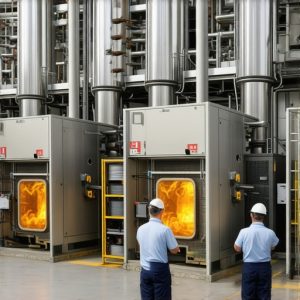
When we talk about warehouse comfort, we have to talk about the floor. Radiant floor heating installation is the gold standard for loading docks for a reason. It turns the concrete slab into a giant thermal battery. When the door opens, the air might get cold, but the ‘sensible heat’ stored in the slab doesn’t just disappear. The moment the door closes, the recovery time is near-instant because you aren’t waiting for the air to warm up the objects; the objects are already warm. This is where we see the biggest ROI for hotel boiler services and large industrial plants. They’re moving away from forced air and toward hydronic systems that stay ‘beer can cold’ on the return line but keep the floor ‘Suction Line’ steady.
For the smaller spaces, like the shipping offices or the crawl space heating solutions required for plumbing protection, we’re seeing a massive shift toward voice control setup Alexa Google. While it sounds like a gimmick, for a manager overseeing 100,000 square feet, being able to adjust the setpoints of thirty different zones via a tablet or voice command isn’t just convenient—it’s a necessity for preventing ‘short cycling’ and energy waste. However, these smart systems are only as good as the tech who knows how to calibrate them. You can have the smartest thermostat in the world, but if your pellet stove repair tech didn’t seal the vent pipe with ‘Pookie’ (mastic), you’re still losing efficiency.
“Proper air distribution is the key to thermal comfort, especially in high-infiltration environments like industrial loading docks.” – ASHRAE Standard 55
The 2025 Regulatory Cliff: Low-GWP Refrigerant Retrofits
We are currently staring down the barrel of the A2L transition. The EPA is phasing out R-410A in favor of low-GWP refrigerant retrofits like R-454B and R-32. These are ‘mildly flammable,’ which means my job just got a whole lot more technical. In a warehouse setting, this means we’re installing leak sensors and mitigation fans that are tied directly into the HVAC controls. If you’re still running an old R-22 system, you’re basically driving a classic car with no spare parts. When that compressor burns out and smells like sour acid, you aren’t just looking at a repair; you’re looking at a total system redesign. This is why refrigerant leak detection is no longer optional; it’s a regulatory requirement for these larger charges.
If you’re dealing with a specific zone that won’t stay warm, don’t just assume the heater is broken. Check your static pressure. I’ve gone into ‘cold’ warehouses where the return air was so restricted by stored pallets that the furnace was hitting its high-limit switch and shutting down every ten minutes. It wasn’t a broken part; it was a blocked airway. Before you call for a mini-split troubleshooting, clear the area around your returns. Air is like water; it takes the path of least resistance. If you don’t give it a path back to the coil, it won’t leave the duct. If you need a pro who knows the difference between a loose belt and a dead motor, you know where to go. Reach out to someone who actually knows how to use a manometer.