The coldest night of the year doesn’t announce itself with a bang; it announces itself with a pathetic, rhythmic clicking. It’s the sound of a 120,000 BTU furnace trying to breathe through a straw. I’ve spent thirty winters pulling my service van up to houses where the homeowner is shivering under three blankets because a ‘trunk-slammer’ installer thought 1/2-inch black iron was ‘good enough’ for a high-output system. It never is. Gas pressure is the lifeblood of your heating system, and if you starve the beast, the beast will eventually bite back in the form of a cracked heat exchanger or a soot-clogged manifold.
The Mentor’s Wrath: A Lesson in Gas Volume
My old mentor, a man who had forgotten more about gas line installation for furnaces than most ‘Sales Techs’ will ever know, used to scream at me on job sites. He once grabbed a manifold with a pipe wrench and yelled, ‘You can’t cook what you can’t fuel! If the pressure drops, the flame goes lazy, and a lazy flame is a killer!’ He was right. Most techs focus on the spark, but the physics of the fuel is where the real engineering happens. We are dealing with Water Column (W.C.), not just PSI. If you don’t have the volume, you don’t have the heat. This is why annual heating inspection routines are critical; we aren’t just looking for dust, we’re looking for signs that the furnace is starving for fuel.
“Gas piping shall be sized to supply the maximum demand of all appliances while maintaining a minimum required pressure at the inlet of each appliance.” – NFPA 54: National Fuel Gas Code
The Forensic Diagnosis: Why Your Furnace is ‘Woofing’
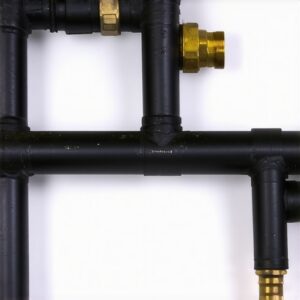
When I walk into a mechanical room and hear a furnace making a ‘woofing’ sound—a low-frequency vibration during ignition—I don’t look at the igniter first. I look at the pipe. This is Blueprint A: The Forensic Diagnosis. The anatomy of a gas system is much like a human circulatory system. If the ‘arteries’ (the main gas line) are too narrow, the ‘heart’ (the furnace) has to work harder. In a high-BTU furnace, especially those pushing 100k to 150k BTUs, the volume of gas required is immense. If the pressure drops below 3.5 inches W.C. for natural gas at the manifold, the venturi effect—where gas pulls in oxygen for combustion—fails. You get a ‘fat,’ yellow flame instead of a crisp, blue one. That yellow flame creates soot, and soot is an insulator. Now your heat exchanger is getting coated in black gunk, and your efficiency just went out the window. This is exactly why furnace repair services often end up being ‘replacement services’ because the initial installation was botched by someone who didn’t understand equivalent length.
Thermodynamic Zooming: The Equivalent Length Trap
Let’s get technical. When we calculate a gas line, we don’t just measure the straight run. We look at ‘Equivalent Length.’ Every 90-degree elbow you install is like adding 2 to 5 feet of straight pipe in terms of friction loss. If you’re running a line through a crawlspace with ten elbows, you’ve just added 30 feet of ‘invisible’ pipe. This is where a Sparky or a Tin Knocker trying to play plumber gets into trouble. They see a 20-foot run and think they’re safe. They aren’t. If you’re also running hotel boiler services or complex snow melt systems installation, the load calculations become even more rigorous. A snow melt system can pull massive BTUs, and if it’s on the same header as your furnace, you’ll see the furnace flame drop the moment the driveway starts heating up.
The Anatomy of Failure: Beyond the Gas Line
It’s not always the pipe size. Sometimes it’s the furnace flame sensor cleaning that was skipped for five years. A dirty sensor won’t recognize the flame, causing the board to shut down the gas valve—a safety feature that saves lives but causes headaches. Or perhaps it’s a contactor repair on the inducer motor circuit. If that inducer isn’t pulling a vacuum, the pressure switch won’t close, and no gas flows anyway. For those in drier climates, evaporative cooler services might be the focus in summer, but the moment that first frost hits, the furnace is expected to perform perfectly. If you haven’t had a dryer vent cleaning lately, you’re also dealing with backpressure issues that can affect the overall pressure balance in a tight mechanical room. If you want to avoid these traps, checking out hvac repair secrets to boost efficiency is a good start to understand how all these systems interlock.
“The most expensive equipment in the world cannot overcome a bad duct system—or an undersized gas header.” – Industry Axiom
The Cold Climate Reality: Why BTU Matters in the North
In the North, we deal with sensible heat and the brutal reality of the polar vortex. When the ambient temp drops to -10°F, your furnace runs for hours. If that gas line is undersized, the manifold pressure will sag as the gas meter struggles to keep up with the demand of the furnace, the water heater, and maybe that biomass boiler services backup you have in the garage. This constant ‘low-fuel’ state causes the heat exchanger to expand and contract unevenly, leading to cracks. A cracked heat exchanger is an automatic ‘red tag’—I’ll shut your system down faster than a Sales Tech can pull out a financing contract. It’s a matter of CO poisoning, and I don’t gamble with lives. If you’re hearing strange noises or your heat feels ‘weak,’ you might need to check furnace repair myths debunked to see if your ‘normal’ is actually a disaster waiting to happen.
Maintenance vs. The Scam Tune-Up
Don’t fall for the $29 ‘tune-up’ where a guy in a clean shirt just wipes down the cabinet. A real annual heating inspection involves a manometer. We measure the static pressure of the gas, the pressure drop when the burners kick in, and the manifold pressure. We check the ‘Pookie’ (mastic) on the plenum to ensure you aren’t leaking heated air into the attic. We look at the gas line installation for furnaces to ensure there’s a drip leg (dirt pocket) to catch debris before it hits the valve. If your tech doesn’t own a manometer or a combustion analyzer, he’s just a glorified janitor. For those using more modern tech, like heat pumps, the rules change, but the need for precision doesn’t; see the ultimate guide to heat pump maintenance for that side of the coin. If you’re struggling with a specific unit like a ductless system, you can find help with mini split troubleshooting. If you’re ready to get your gas pressure checked properly, contact us today before the next cold snap hits.