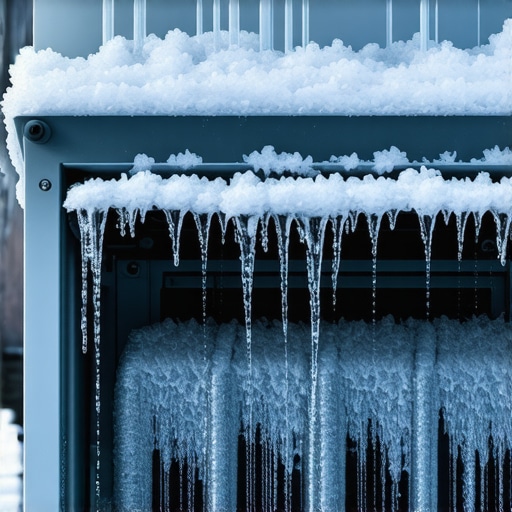
You hear that? That rhythmic thumping coming from the mechanical room while the wind howls at twenty below? That is the sound of your Heat Recovery Ventilator (HRV) fighting a losing battle against physics. Most homeowners don’t give their ventilation a second thought until the house starts smelling like last week’s fish or the windows are dripping with enough condensation to fill a bucket. My old mentor, a grizzled veteran who could diagnose a bad capacitor by the smell of the air, used to scream at me, ‘You can’t heat what you can’t move! The air is a fluid, and if you don’t treat it like one, it’ll bite you.’ He called the HRV the ‘Invisible Lung’ of the modern house, and he was right. In these sub-zero climates, your HRV isn’t just an accessory; it is a critical component that requires precise management to avoid turning into a solid block of ice.
The Forensic Diagnosis: Anatomy of a Frozen Core
An HRV works on a simple principle: it takes the stale, warm air from your kitchen and bathrooms and passes it through a honeycomb-like core. Simultaneously, it pulls in fresh, freezing air from outside. The two streams never mix—they just trade heat. But here is where the ‘Thermodynamic Zooming’ comes in. That warm indoor air contains moisture (latent heat). When it hits the sub-freezing surfaces of the core being chilled by the intake air, that moisture reaches its dew point and flash-freezes. Without a proper defrost cycle, your HRV core becomes a literal ice cube in less than an hour. This is why airflow measurement services are so vital; if the balance is off, the ice buildup happens even faster.
“The most expensive equipment in the world cannot overcome a bad duct system.” – Industry Axiom
When the unit detects this frost—usually via a temperature sensor or a pressure drop—it enters a defrost cycle. Some units do this by shutting off the fresh air intake and recirculating warm house air through the core to melt the ice. Others use a damper to bypass the cold air. If you have a ‘Sales Tech’ trying to tell you that your unit is ‘broken’ because it stops pulling in fresh air every thirty minutes in January, they are either lying or shouldn’t be holding a manifold gauge. They’re probably looking to push a warranty service plans sale instead of actually checking the thermistor or the damper motor. I’ve seen guys try to quote a full replacement when a simple furnace repair or sensor cleaning was all that was needed. If you want the truth about your system, check out furnace repair myths debunked.
The Pressure of Modern Living: Air Purification and Zoning
In high-efficiency homes, especially those with radiant floor heating installation, the HRV is the only thing keeping the air from becoming toxic. Radiant heat doesn’t move air, so you don’t get the filtration you’d get from a standard forced-air furnace. This is why air purification integration is so often tied directly into the HRV ductwork. We are essentially applying hospital HVAC zoning logic to residential builds now. In a hospital, you have to manage pressure to keep the germs from moving; in your home, we’re managing pressure to keep the moisture from rotting your wall studs.
If you’ve recently undergone an oil to gas conversion, you’ve likely increased your home’s efficiency, but you might have also tightened up the envelope. A tighter home means more moisture trapped inside. If you decide to add a wood burning stove installation or fireplace insert services for that cozy winter vibe, you’re creating a massive demand for combustion air. If your HRV isn’t balanced or if the defrost cycle isn’t functioning, that wood stove will start pulling air down your water heater vent or your steam boiler repair stack, bringing deadly carbon monoxide with it. This is why I always check the ‘Suction Line’ and the static pressure before I sign off on a job.
Physics vs. The Scam: The Cost of Neglect
Let’s talk about the ‘Pookie’ (mastic). A lot of ‘Tin Knockers’ get lazy and use cheap tape on HRV ducts. In sub-zero temps, that tape fails, and you start leaking conditioned air into your unconditioned attic. Now you’re paying to heat the squirrels while your HRV core freezes because it’s not getting the return air it needs. I’ve followed behind ‘Sales Techs’ who quoted homeowners $15,000 for a new system because they didn’t understand the latent heat load of a family of five. All the house needed was a proper defrost timer adjustment and some airflow measurement services to balance the ‘Gas’ flow and the air velocity.
“Ventilation shall be provided to maintain indoor air quality in accordance with ASHRAE 62.2 standards, ensuring that mechanical systems account for climatic extremes.” – ASHRAE Standards
If you are dealing with a system that seems to be struggling, don’t wait for the ‘Sparky’ to tell you it’s an electrical issue. It’s almost always a physics issue. For those using heat pumps in these climates, the struggle is even more real. You can read more about that in our ultimate guide to heat pump maintenance and repairs. Keeping your coils clean and your drains clear is the difference between a comfortable winter and a $800 emergency call-out on Christmas Eve. If your unit is making a screeching sound—that’s likely a bearing failing due to the high static pressure of a blocked, frozen core. It’s a domino effect that ends with a dead compressor and a very angry checkbook.
The Final Verdict on Sub-Zero Operation
Repairing an HRV core ($500-$900) is a lot cheaper than replacing the whole unit because the fans burned out trying to push air through a block of ice. If you see ice forming on the outside of your HRV cabinet, call a pro immediately. Don’t let a ‘Sales Tech’ talk you into a new furnace when your HRV is just having a cold snap breakdown. For more technical insights, check our HVAC repair secrets to keep your system running like a top when the mercury drops. Remember: airflow is king, and moisture is the enemy. Keep your defrost cycles long and your ‘Pookie’ thick. If you’re still having trouble, you know how to contact us.