The Ghost in the Basement: Why 2026 is the Year of the Boiler Reckoning
There is a specific sound a 1.5 million BTU steam boiler makes when the low-water cutoff fails and the dry-fire begins. It is a rhythmic, metallic groaning—the sound of cast iron expanding past its structural limits. I heard it once in the dead of winter at a district middle school back in ’94. My old mentor, a man who had more soot in his lungs than a chimney sweep, grabbed me by the collar and dragged me toward the exit. ‘You can’t heat what you’ve already melted, kid!’ he yelled. He used to scream that airflow and water level mattered more than the nameplate on the jacket. That lesson stuck. You can have the most expensive hydronic system on the planet, but if the physics of heat transfer aren’t respected, you’re just sitting on a very expensive, very dangerous pressure cooker. As we approach 2026, the stakes for boiler maintenance services are rising. We are moving into an era of stricter emissions, the phase-out of legacy refrigerants affecting our backup systems, and a desperate need for commercial furnace repair that actually understands the chemistry of combustion, not just how to swap a sensor.
1. The Low Water Cut-Off (LWCO) and the Physics of Catastrophe
In the HVAC world, we don’t ‘top off’ systems. If you’re adding water to a closed-loop boiler every week, you don’t have a maintenance schedule; you have a leak. The LWCO is the most critical safety device in a school’s mechanical room. Its job is simple: if the water level drops below a safe point, it kills the burner. But scale—that white, crusty buildup of calcium and magnesium—loves to settle in the float chamber.
“The inspection of low water fuel cutoff devices shall be performed periodically to ensure the protection of the pressure vessel from dry-firing conditions.” – ASME CSD-1
When scale locks that float in the ‘up’ position, the burner stays on even as the crown sheet turns cherry red. During a 24/7 heating emergency response, I’ve seen boilers where the internal heat grew so intense it actually warped the steel fire tubes. In 2026, with the push for higher efficiency, these sensors are becoming more digital and less mechanical, meaning your ‘Sparky’ (electrician) and your HVAC tech need to be on the same page about signal continuity. If you aren’t blowing down your LWCO weekly, you’re inviting a disaster that no insurance policy will cover.
2. Combustion Analysis: The Silent Killer and the AFUE Reality
Most schools in the North deal with the ‘Polar Vortex’ effect. When the mercury hits -10°F, boilers ramp up to full fire. This is when the danger of carbon monoxide (CO) peaks. A cracked heat exchanger isn’t always a gaping hole; sometimes it’s a hairline fracture that only opens when the metal reaches 400°F.
“Annual combustion analysis is mandatory to prevent the accumulation of carbon monoxide and ensure proper AFUE performance in commercial installations.” – ASHRAE Standard 155P
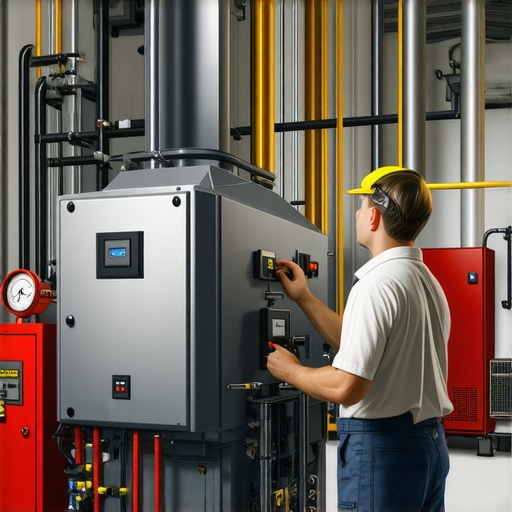
We use a digital analyzer to check the ‘Juice’—the fuel-to-air ratio. If the burner is running ‘lean,’ you’re wasting money. If it’s running ‘rich,’ you’re producing soot and CO. This is why emergency heating repair is so often just a result of poor tuning. You can’t just eyeball a flame and say it looks ‘blue enough.’ You need to measure the O2, CO2, and stack temperature. If your tech isn’t sticking a probe into the flue, they aren’t doing a safety check; they’re doing a drive-by. This is especially true if the school uses ventless gas heater services in temporary classrooms, where ventilation is even more critical. You can learn more about keeping these systems tuned in our hvac repair secrets guide.
3. Pressure Relief Valve (PRV) Integrity: The Last Line of Defense
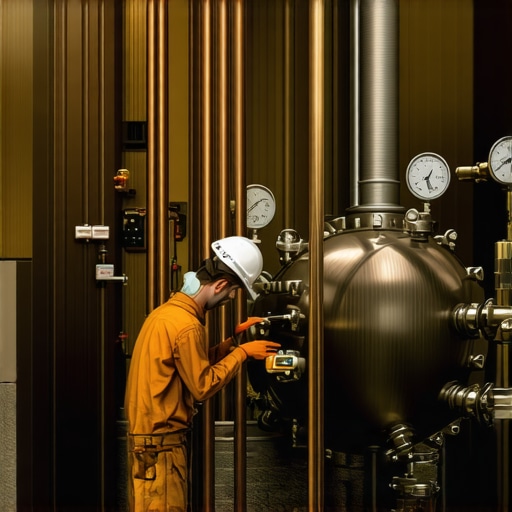
The PRV is a mechanical spring-loaded valve designed to pop before the boiler becomes a rocket. In my thirty years, the scariest thing I see is a PRV with a ‘weep’ that someone has plugged with a pipe cap. Never, ever plug a leaking PRV. That leak is a symptom of a waterlogged expansion tank or a failing feed valve. By 2026, many school districts are looking into financing for heat pump installs to supplement these old boilers, but the steam or hot water infrastructure remains. If the PRV is crusty with ‘Pookie’ (mastic) or corrosion, it won’t lift when it needs to. During a high-load event, that pressure has to go somewhere. Usually, it’s through the weakest part of the masonry. Checking the ‘set point’ and ensuring the discharge piping is routed to a floor drain—not at a technician’s face—is Boiler 101. If your current service provider hasn’t manually tripped the PRV to check for seating, they’re failing you.
4. The Hydronic Balance and ‘Tin Knocker’ Logic
Heating a school isn’t just about the boiler; it’s about the distribution. This is where ductless mini-split installation and humidifier installation come into play for specific zones like computer labs or libraries. However, the main loop depends on static pressure. If the pumps are cavitating because of air in the lines, you’re not moving heat; you’re just moving bubbles. We call this ‘Thermodynamic Zooming’—you have to look at how the latent heat is being exchanged at the terminal units (radiators). If a classroom is freezing, don’t just crank the boiler. Check the bypass humidifier repair or the zone valves. Often, the issue is a ‘Sales Tech’ told the school they needed a new $50,000 boiler when they really just needed a $200 air air-eliminator and a proper ‘Tin Knocker’ (duct specialist) to fix the return air. For more on these common misconceptions, check our furnace repair myths debunked article.
5. The 2026 Regulatory Cliff: R-454B and the Death of R-410A
While boilers use water and fire, many schools use hybrid systems with heat pumps. The transition to A2L refrigerants (like R-454B) in 2025 and 2026 means that electric heater services and heat pump maintenance are changing. These new ‘mildly flammable’ refrigerants require specialized leak detection and sensors. If your school is planning an upgrade, you need to understand that the old ‘sealed system’ rules still apply, but the tools have changed. You can’t just use your old ‘suction line’ (beer can cold) logic anymore. Precise subcooling and superheat measurements are the only way to ensure these units don’t ‘short cycle’ and burn out their compressors within three years. If you’re struggling with a newer unit, our guide on mini-split troubleshooting can help identify when the electronics are the culprit vs. the mechanics. School safety isn’t just about locks on doors; it’s about the pressure in the pipes and the air in the vents. Don’t let a ‘Sales Tech’ talk you into equipment you don’t need when a veteran’s touch can keep the old iron breathing for another decade.