The Sound of a Dying Mechanical Heart
You hear it before you feel the chill. It starts as a low-frequency vibration that rattles the floorboards, then graduates to a high-pitched metallic shriek that sounds like a circular saw cutting through a frozen steak. That’s the draft inducer motor—the unsung sentinel of your heating system—telling you it’s about to give up the ghost. As a tech who’s spent three decades belly-deep in crawlspaces, I can tell you that a noisy inducer is more than an annoyance; it’s a safety lockout waiting to happen. In the world of 2026 furnace repair services, we aren’t just looking at metal and grease anymore; we’re dealing with integrated sensors and predictive maintenance alerts that tell us exactly when a bearing is failing before the homeowner even notices the noise.
The Sales Tech Scam: A Forensic Discovery
I remember walking into a basement in the dead of February last year. The homeowner was white as a sheet because a ‘comfort consultant’ from a big-box HVAC firm had just left. He’d told her that her 80% AFUE furnace had a ‘catastrophic failure’ and quoted $12,000 for a rush replacement, citing ‘carbon monoxide risks’ that he didn’t even bother to measure with a combustion analyzer. I pulled the panel, and sure enough, the draft inducer was screaming. But it wasn’t a cracked heat exchanger. It was a $300 motor with a dry bearing and a bit of debris in the housing. I had her heat back on in forty minutes. This is why I loathe ‘Sales Techs.’ They don’t want to fix your air; they want to hit their commission. True HVAC work is about understanding the thermodynamics of the machine, not the aerodynamics of a sales pitch.
“Proper venting and combustion air are critical; an inducer must move a specific mass flow of air to ensure the pressure switch proves the circuit.” – ASHRAE Standards Handbook
The Anatomy of the Draft Inducer
Before we dive into the repair, you need to understand what this thing actually does. In a modern furnace, the inducer is a small centrifugal blower that pulls the products of combustion—the toxic stuff—through the heat exchanger and pushes it out the flue. It’s the first thing that turns on. If it doesn’t spin up to the right RPM, the pressure switch won’t close, the hot surface igniter won’t glow, and you’ll be left in a cold house. We call this the ‘pre-purge’ cycle. In newer two-stage furnace installations, these motors are often variable speed, which makes them quieter but more prone to electronics failure if the static pressure is too high.
Step 1: Decoding the Predictive Maintenance Alert
By 2026, most high-efficiency systems are equipped with vibration sensors and amp-draw monitors. If your geofencing temperature control system sends a push notification to your phone saying ‘Furnace Component Stress,’ don’t ignore it. This is the predictive maintenance alert in action. When a bearing starts to pit, the motor draws more ‘juice’ (amperage) to maintain its RPM. A professional will use a multimeter to check the ‘common’ and ‘run’ wires. If the nameplate says 1.2 amps and you’re pulling 1.8, the motor is fighting internal friction. This is also the time to check your leak detector integration; if the inducer housing is cracked, it can leak acidic condensate which eats through the motor shaft. If you catch it early, you avoid the ‘no-heat’ emergency call on a Saturday night.
Step 2: The Mechanical ‘Spin Test’ and Voltage Verification
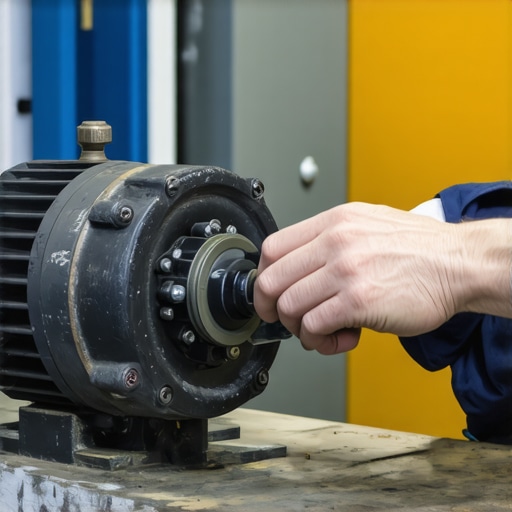
If you’re out of the ‘predictive’ loop and into the ‘shrieking’ phase, turn off the breaker. Open the burner door and find the circular motor assembly. Give the cooling fan on the back of the motor a flick. If it resists or feels ‘crunchy,’ the bearings are shot. You can’t just spray WD-40 in there; these are sealed units. If it spins freely, the noise might be a piece of scale or a dead bird that made it down the flue. Also, check the voltage. A ‘Sparky’ might tell you it’s a power issue, but usually, it’s just a failing capacitor or a worn-out winding. If you find the motor is getting 120V but won’t turn, she’s dead, Jim. For those with solar thermal heating integration, ensure your inverter isn’t sending ‘dirty’ power that’s cooking these sensitive ECM inducer motors.
Step 3: The Swap and Duct Sealing Synergy
Replacing the motor involves more than just three screws. You need to ensure the gasket is perfect. Any air leak here ruins the static pressure and can trip the pressure switch. While I’m in there, I always check the venting. Many ‘tin knockers’ (duct guys) forget that the flue is part of the airflow system. If the flue is restricted, the inducer works harder and dies faster. This is also a prime time to look at HVAC duct sealing. If your return air is pulling in dusty attic air because of ‘pookie-less’ joints, that dust ends up on the inducer wheel, unbalancing it and causing the very vibration that kills the motor. Sealing those leaks with mastic (the real stuff, not tape) ensures the whole system breathes easily. HVAC repair secrets often come down to these small, unsexy details.
“The most expensive equipment in the world cannot overcome a bad duct system.” – Industry Axiom
Beyond the Motor: Humidification and Safety
In cold climates like Chicago or the Northeast, we deal with dry air that cracks heat exchangers. Integrating steam humidifiers can actually help your furnace components last longer by maintaining a consistent indoor environment that reduces the expansion and contraction cycles of the metal. If your furnace is truly at the end of its life, don’t just grab the cheapest thing. A two-stage furnace installation paired with infrared heater installation in cold spots like garages can provide a much more balanced thermal envelope. And for the love of all things holy, if you’re using space heaters while waiting for a repair, do your portable heater safety checks—don’t plug them into power strips.
The Verdict: Repair or Replace?
A draft inducer repair usually runs between $400 and $900 depending on the brand and if it’s a communicating motor. If your furnace is over 15 years old and you’re already seeing signs of a cracked heat exchanger (like flame rollout or a sour smell), it’s time to pull the plug. However, if the heat exchanger is clean, don’t let a sales tech talk you into a $15k system just because of a loud motor. Learn more about common scams in our furnace repair myths debunked guide. Keeping your current system alive with high-quality parts is often the most sustainable choice. If you’re unsure, contact us for a second opinion before you sign that financing agreement. Comfort isn’t magic; it’s physics. And physics doesn’t lie, even when salesmen do.