
The Echo of Wasted BTUs: Why Your Sanctuary Feels Like an Icebox
Walk into any sanctuary on a Tuesday morning and you’ll feel it—that bone-chilling dampness that seems to seep out of the very stones. As a guy who has spent three decades dragging manifold gauges through crawl spaces and balancing industrial heater services on shaky ladders, I can tell you exactly what’s happening: you are literally burning money to heat the angels. My old mentor used to scream at me during my apprenticeship, ‘You can’t cool what you can’t touch, and you can’t heat what isn’t there!’ He was a grizzled tin knocker from the old school who understood that airflow matters more than horsepower. He’d point his infrared thermometer at the 40-foot ceilings and then at the shivering pews. The ceiling was 85°F, and the floor was 58°F. That, my friends, is a physics failure, not a furnace failure.
“The most expensive equipment in the world cannot overcome a bad duct system.” – Industry Axiom
Thermodynamic Zooming: The Physics of the Empty Pew
To understand why your church budget is hemorrhaging, we have to look at the sensible heat—the actual temperature change we can measure. In a massive open space like a cathedral or a modern sanctuary, air undergoes stratification. Because hot air is less dense (roughly 0.075 lbs per cubic foot at standard temperature), it naturally wants to rise. This creates a ‘thermal stack.’ If your duct design services didn’t account for high-volume returns or de-stratification fans, you are stuck in a cycle where the furnace runs 24/7, the limit switch is constantly tripping because the plenum is overheating, and the congregation is still wearing coats during the sermon. When we talk about thermostat wiring upgrades, we aren’t just talking about a shiny new screen; we are talking about multi-stage logic that knows when to engage the heat pump and when to kick on the gas backup to prevent short-cycling during the polar vortex.
The Trap of the Massive Unit
I’ve seen plenty of ‘Sales Techs’—the guys who look like they’ve never seen a day of pookie on their hands—try to sell churches a 20-ton monster system to fix a comfort problem. They claim more juice (refrigerant) and more BTUs will solve it. They are lying. An oversized unit in a cold climate will hit the setpoint too fast, shut down, and leave the air stagnant. In the HVAC world, we look at AFUE (Annual Fuel Utilization Efficiency). If you’re running an old 80% furnace, 20 cents of every dollar is literally going out the chimney. Upgrading to a high-efficiency system requires more than just swapping boxes; it requires duct design services to ensure the static pressure doesn’t kill your new blower motor. If you’re seeing signs of trouble, don’t fall for the furnace repair myths debunked by common ‘experts’ who just want to sell you a new heat exchanger.
High-Performance Solutions: From Crawl Spaces to Solar Thermal
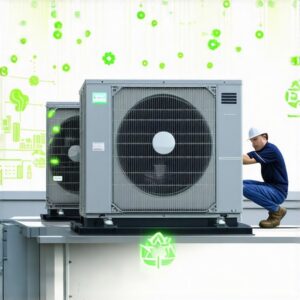
If your church sits on an old foundation, crawl space heating solutions are non-negotiable. Frozen pipes under the floorboards aren’t just a plumbing risk; they act as a massive heat sink, sucking the warmth out of the floorboards. We often recommend solar thermal heating integration for churches with large, south-facing roof spans. By pre-heating the air or water used in your system, you reduce the load on your primary boilers or furnaces. For many modern ministries, financing for heat pump installs has become the only way to pivot away from skyrocketing natural gas prices. These systems, especially when paired with industrial heater services for gymnasiums, provide a level of modulation that old-school ‘on/off’ furnaces can’t touch. [IMAGE_PLACEHOLDER]
The Component Anatomy: Why Your Limit Switch is Screaming
The limit switch replacement is one of the most common service calls I get in the winter. This little bimetallic disc is the ‘brain’ that prevents your heat exchanger from melting. In a church, where filters are often neglected for months, the airflow drops, the temperature inside the furnace cabinet soars, and the limit switch ‘pops’ to save your life. If your system is constantly resetting, you don’t need more ‘gas’; you need a sparky or a tech to check your thermostat wiring upgrades and your static pressure. Proper heat pump installation requires a deep understanding of the ‘balance point’—the outdoor temperature where the heat pump can no longer keep up and the electric heat strips take over. Without a professional ultimate guide to heat pump maintenance and repairs, most church maintenance committees are just guessing, and guessing gets expensive.
“Standard 62.1 requires specific ventilation rates to ensure indoor air quality, but in large volume spaces, the interaction between thermal plumes and mechanical exhaust is often misunderstood.” – ASHRAE Standards
The Strategy for Smaller Chapels: Mini-Split Power
For smaller rooms like the pastor’s study or the choir loft, stop trying to duct everything into the main system. Use a ductless mini-split. It allows for localized control so you aren’t heating the whole 5,000-square-foot building just because one person is working in the office. If you run into issues, knowing mini-split troubleshooting can save a Sunday morning disaster. We focus on thermostat wiring upgrades that allow for remote lockout, preventing the ‘thermostat wars’ between the ushers who are hot and the seniors who are cold. This is where comfort is physics: by controlling the velocity of the air at the suction line and managing the latent heat (moisture) during the summer, we create an environment where the building itself stays ‘tempered’ rather than constantly fighting a 20-degree swing.
Closing the Gap: Maintenance vs. Crisis
The secret to saving your church’s building fund isn’t a miracle; it’s a maintenance contract. You need to ensure the pookie is still sealing those duct joints, that the tin knocker didn’t leave a gap in the return air drop, and that your limit switch is functional. If you’re tired of the ‘Sales Tech’ shuffle and want real industrial heater services or help with financing for heat pump installs, you need to talk to someone who knows the difference between a capacitor and a contactor by the sound they make when they fail. Check out these hvac repair secrets to stay ahead of the curve. Don’t wait until the pipes burst in the crawl space to think about your duct design services. Contact the pros at Chilly Pro HVAC today to schedule a walkthrough of your facility.