The Ghost in the Pipes: Why Your Steam System is Screaming
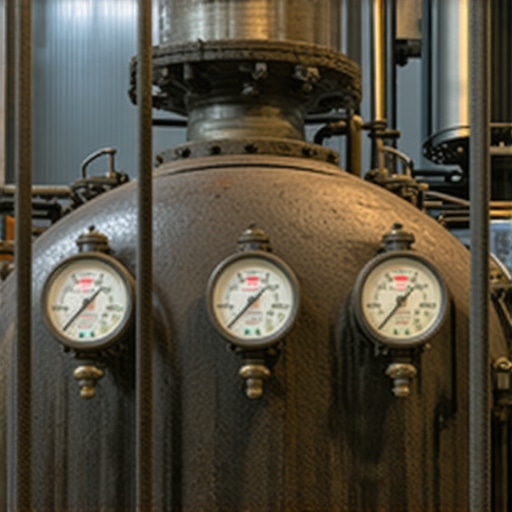
You’re lying in bed at 3 AM in the middle of a January cold snap, and it starts. CLANG. BANG. THUD. It sounds like a frantic tin knocker is trapped inside your walls with a ball-peen hammer. In my thirty years of crawling through damp basements and dodging asbestos-wrapped mains, I’ve heard every excuse from ‘it’s just the house settling’ to ‘that’s just what boilers do.’ Wrong. That noise is a cry for help from a system struggling with the laws of thermodynamics. My old mentor, a man who could sniff out a gas leak from a block away, used to scream at me, ‘You can’t heat what the steam can’t reach!’ He was obsessed with the idea that the steam is just the messenger; if the messenger is getting mugged by cold condensate on its way to the radiator, you’re losing the war against the North’s biting chill. This is the core of the ‘Forensic Diagnosis’: we don’t just look at the boiler; we look at the entire circulatory system of your home.
“The most expensive equipment in the world cannot overcome a bad duct system—or in the case of steam, a poorly pitched main.” – Industry Axiom
The Physics of the ‘Bang’: Water Hammer and Latent Heat
When your boiler fires up, it’s performing a miracle of phase change. It’s taking water and shoving enough BTUs into it to turn it into steam. That steam wants to expand and move toward the low-pressure zones—your radiators. But here is where the ‘Forensic Diagnosis’ gets messy. If your pipes aren’t pitched correctly, or if your steam traps are failed shut, that steam hits a wall of stagnant, cooling water (condensate). The steam collapses, creates a vacuum, and pulls a slug of water at high velocity into the nearest elbow. Bang. That’s not just noise; that’s kinetic energy trying to rip your pipe hangers out of the joists. If you’re dealing with furnace repair myths, you might think a little noise is normal. It’s not. It’s an efficiency killer.
Fix 1: The Heartbeat—Thermocouple Replacement & Flame Sensor Cleaning
In the world of 2026 boiler tech, safety is paramount. I’ve seen too many ‘Sales Techs’ try to condemn a perfectly good cast-iron boiler because the pilot won’t stay lit. Usually, it’s a simple thermocouple replacement. This little copper lead is the only thing standing between you and a basement full of unburnt gas. It generates a tiny millivolt signal to the gas valve. If it’s carboned up or burnt out, the system dies. Similarly, on modern high-efficiency units, furnace flame sensor cleaning is the most overlooked maintenance task. If that sensor doesn’t ‘see’ the flame within microseconds of ignition via flame rectification, it shuts down the ‘juice.’ We’re talking about a five-minute fix that saves a $300 emergency ‘no heat’ call. Whether it’s a residential unit or a high-stakes commercial furnace repair, the logic is the same: no signal, no fire.
Fix 2: Precision Combustion Analysis—The 2026 Regulatory Mandate
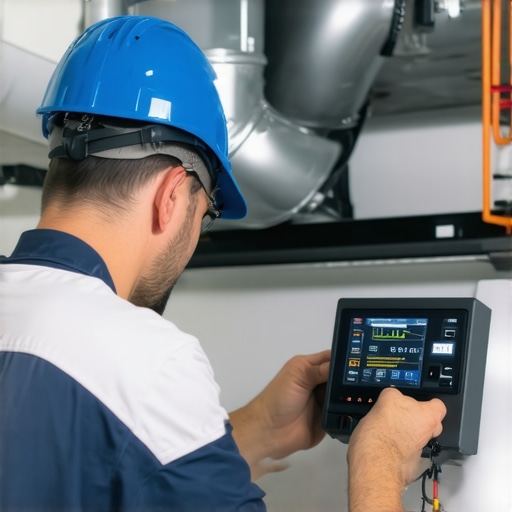
By 2026, the EPA isn’t playing around anymore. We’re moving toward tighter AFUE (Annual Fuel Utilization Efficiency) standards. You can’t just ‘eyeball’ a flame anymore. I carry a digital combustion analyzer that tells me the exact percentage of CO, CO2, and O2 leaving your chimney. If your fuel-to-air ratio is off, you’re essentially throwing ‘gas’ out the flue. Combustion analysis is the only way to ensure your burner is tuned for the maximum release of latent heat. If I see high CO levels, I’m looking for a cracked heat exchanger—a death sentence for any unit. This is why professional furnace repair is about more than just getting it to turn on; it’s about making sure it doesn’t kill you in your sleep with the ‘silent killer.’
Fix 3: Beyond the Boiler—Bypass Humidifier Repair & Air Purification Integration
In a cold climate like Chicago or the Northeast, the air gets so dry it’ll crack your skin and your hardwood floors. A boiler doesn’t move air, so how do we fix it? Many homeowners are moving toward air purification integration and bypass humidifier repair within their supplemental air systems. If your humidifier is leaking or the pad is calcified, it’s not doing a lick of good. We also see a surge in hot water heater repair integration where the boiler serves as a side-arm heater for domestic water. It’s efficient, but it adds complexity. If that internal coil leaks, you’re mixing ‘boiler juice’ with your shower water. Not a great way to start the morning.
“Proper maintenance is the difference between a 30-year boiler and a 10-year scrap heap.” – ASHRAE Standard 150
Fix 4: The Hybrid Shift—Ductless Mini-Split Installation
Look, I love steam. I love the radiant heat that feels like a warm hug. But steam is terrible at ‘zoning.’ This is why in 2026, we are seeing a massive trend in ductless mini-split installation as a supplement to old boiler systems. Why fire up a 200,000 BTU boiler just to heat one bedroom? A mini-split allows you to ‘zone’ your comfort. But don’t think they’re maintenance-free. If you run into issues, check my mini-split troubleshooting guide before you call the sparky. These systems use R-454B now, the new ‘mildly flammable’ refrigerant, and they require a pro who knows how to handle the high head pressures of a sub-zero night.
The Financial Reality: Repair ($500) vs. Replace ($12,000)
When I walk into a mechanical room, I’m doing math. If your boiler is a 40-year-old ‘Old Reliable’ with a thick cast-iron section, a thermocouple replacement and a good cleaning might buy you another decade. But if the sections are weeping or the ‘pookie’ (mastic) holding the flue together is disintegrating, it’s time to talk. Don’t let a ‘Sales Tech’ scare you into a new system because of a dirty flame sensor. However, if your steam mains are so ‘slugged’ with rust that the water hammer is breaking glass, you’re fighting a losing battle. You can find more hvac repair secrets to help you decide, but usually, if the repair cost exceeds 50% of the value of a new, high-efficiency system, it’s time to pull the plug. For those with supplemental electric heat, don’t forget that electric heater services are often more expensive per BTU than gas, so keep that boiler running tight. If you’re ready to stop the banging and start saving, contact us today for a real tech, not a salesman.