It’s three in the morning in the middle of a January cold snap, and the silence in your house is louder than a freight train. That silence means the heat is out. As a tech who has spent thirty years crawling through fiberglass-filled crawlspaces and shivering on rooftops, I can tell you that silence is usually preceded by a warning that most homeowners ignore until the unit is a total loss. In my three decades, I’ve seen everything from ‘Sales Techs’ trying to push a fifteen-grand system for a blown fuse to ‘Tin Knockers’ who couldn’t balance a duct system if their lives depended on it. But nothing is more critical than the electrical integrity of your system. My old mentor used to scream, ‘You can’t heat what you can’t touch!’ This is why airflow matters more than horsepower. If the air isn’t moving across the heat exchanger or the evaporator coil, the physics of heat transfer simply stops working. We call this ‘Thermodynamic Zooming’—looking past the metal box and understanding that your HVAC is a living, breathing lung. When that lung has frayed heating wires, you aren’t just looking at a repair; you’re looking at a potential fire hazard or a fried control board that will cost you a fortune in 2026.
The Sensory Warning: When Your Nose Knows Before Your Thermostat
The first sign of frayed heating wires is the smell. I’m not talking about that ‘dust burning off’ smell you get during the first cold day of the year. I’m talking about the acidic, sharp ozone scent of electrical arcing. When wire insulation breaks down—often due to years of mechanical vibration in an imbalanced blower motor—the copper starts talking to the chassis. This ‘arcing’ creates heat that far exceeds what the wire was designed for. In the trade, we call the electrician a ‘Sparky,’ but you don’t want to see a sparky or an HVAC pro under these circumstances. Frayed wires increase resistance. In electrical terms, resistance equals heat. If your air handler repair isn’t handled early, that resistance will melt the plastic molex connectors and can even lead to a cracked heat exchanger if the blower fails to start.
“The most expensive equipment in the world cannot overcome a bad duct system or faulty internal wiring.” – Industry Axiom
This is why HVAC repair secrets often center on the simple stuff: tight connections and clean paths for the ‘juice’ to flow.
The Sound of Resistance: Chattering Contactors and Clicking Boards
The second sign is auditory. If you hear a rapid-fire clicking coming from your closet or attic, that’s your contactor trying to pull in but failing because the frayed wires are starving it of voltage. We’re moving into an era of AI-driven HVAC optimization and app-controlled heating systems, but all the software in the world can’t fix a physical break in a 10-gauge wire. When the voltage drops, the amperage spikes. It’s a basic law of physics. High amperage generates heat that cooks the lacquer off the motor windings. I’ve followed behind too many ‘Sales Techs’ who see a chattering contactor and immediately quote a heat pump installation for $12,000. Half the time, the client just needed a clean wire strip and a new terminal. This is why HVAC load calculation services are vital during any installation; if the unit is oversized, it cycles too often, causing the wires to vibrate and fray prematurely against the cabinet walls.
The Ghost in the Machine: Short Cycling and Voltage Sag
Sign number three is the ‘Short Cycle.’ This is when the unit starts, runs for three minutes, and shuts down without reaching the set point. Most folks think it’s the thermostat. It’s usually not. In hospital HVAC zoning or even residential setups, frayed wires in the safety circuit (like the limit switch or the rollout switch) can create ‘phantom’ breaks. The vibration of the unit running causes the frayed wire to lose contact, telling the board the unit is overheating. It’s a safety feature, but it’s a symptom of a deeper mechanical anatomy failure. If you are looking into financing for heat pump installs because your old unit keeps cutting out, make sure a real tech—not a salesman—checks the low-voltage harness first.
“Provisions shall be made to prevent the stress and strain of electrical conductors at terminals and to prevent the abrasion of wire insulation.” – ASHRAE Standards
Proper duct design services can also reduce this stress; high static pressure makes the motor work harder, shake more, and eat its own wiring.
The Visual Evidence: Carbon Scoring and Pookie Problems
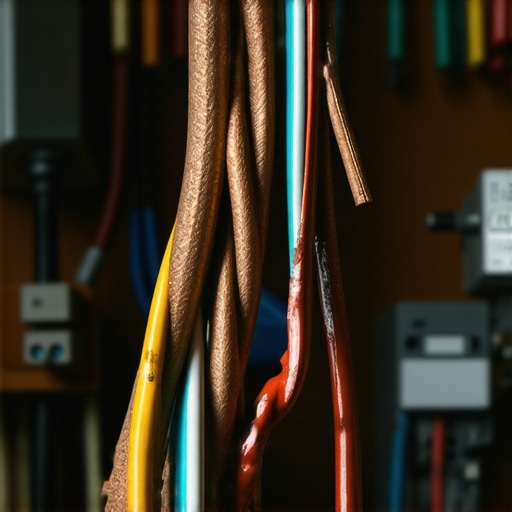
The fourth sign is visual. If you pull the door off your wall furnace installation and see black ‘soot’ or scorched marks on the white wire jackets, you are in the danger zone. We call that carbon scoring. In the HVAC world, carbon is a conductor. Once a wire frays and starts to arc, it creates a carbon path that makes it easier for electricity to jump to the wrong place next time. This is especially dangerous with the 2025/2026 transition to A2L refrigerants, which are ‘mildly flammable.’ You do not want sparks near a modern coil. I’ve seen duct cleaning services accidentally knock these wires loose because they were already brittle from heat. Always check your ‘Pookie’ (mastic) around the cabinet penetrations; if it’s cracked, it might be letting moisture in that corrodes the wires. If you’re struggling with a unit that’s acting up, check out this mini-split troubleshooting guide or read up on furnace repair myths to avoid getting scammed.
Repair vs. Replace: The Forensic Math
When I find frayed wires, I do a forensic audit. If the unit is under ten years old, we repair the harness and look for the root cause—usually an imbalanced blower or poor duct design services. If the unit is twenty years old and the wires look like burnt spaghetti, it’s time to talk about financing for heat pump installs. A repair might cost you $500, but a frayed wire on an old, inefficient motor is just a band-aid on a gunshot wound. Modern units with AI-driven HVAC optimization can actually sense high resistance in the circuits and alert you on your phone before the wire completely melts. This is the future of the trade. If you’re ready to stop guessing and start fixing, visit our contact page or review our ultimate guide to heat pump maintenance. Don’t let a $20 wire turn into a $15,000 emergency on a holiday weekend.“