
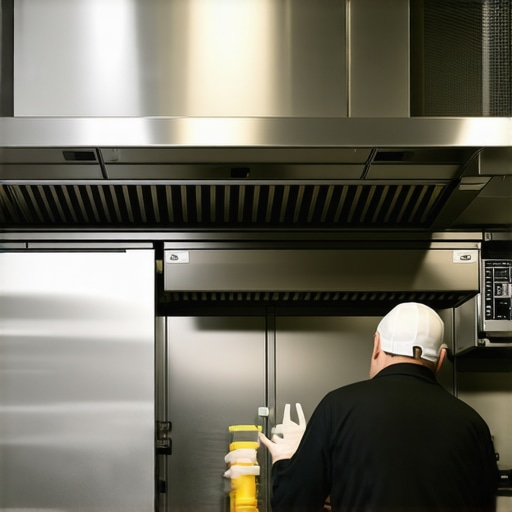
The sound of a failing kitchen exhaust fan is the death rattle of a restaurant’s profit margin. It starts with a rhythmic chirp, barely audible over the clatter of pans and the hum of the prep line. But to a tech who has spent three decades dragging gauges across icy Chicago rooftops, that sound is a frantic signal for help. If you are running a kitchen in 2026, you are not just fighting the heat; you are fighting the physics of a sealed building. In my thirty years of troubleshooting, I have seen it all, and the biggest mistake owners make is thinking the fan is a standalone appliance. It is part of a complex respiratory system, and right now, your kitchen might be suffocating.
The Physics of the Void: Why Airflow is King
My old mentor used to scream, ‘You can’t cool what you can’t touch!’ This is why airflow matters more than horsepower. He would stand in the middle of a 105°F kitchen, point at the grease-clogged hood, and tell me that a 5-ton unit is useless if the static pressure is fighting the blower. In the North, where we deal with brutal winters, the relationship between the exhaust and the make-up air (MUA) is a delicate dance of thermodynamics. When you pull 5,000 CFM (Cubic Feet per Minute) of greasy air out of a building, you have to put 5,000 CFM back in. If you don’t, the building goes into a negative pressure state, and that is when the real trouble begins.
“Exhaust systems shall be designed, constructed and installed such that the systems will properly exhaust grease-laden vapors and smoke to the outside of the building.” – NFPA 96 Standard for Ventilation Control and Fire Protection of Commercial Cooking Operations
When the MUA heater fails, perhaps due to a lack of hvac repair secrets, the kitchen staff starts feeling the ‘Polar Vortex’ effect every time the back door opens. If you are seeing pilot lights go out on your ranges or hearing the front door whistle like a haunted house, you have an airflow crisis, not just a fan problem.
Warning Sign 1: The Harmonic Scream (Bearing and Belt Decay)
The first sign of a mechanical breakdown is sensory. If you hear a high-pitched metallic whine coming from the roof, your bearings are screaming for ‘juice’ (lubricant) or they are already toast. In 2026, we are seeing more high-efficiency motors, but they are still susceptible to the same old-school friction. When a bearing starts to seize, it increases the amp draw on the motor. The motor gets hot—I’m talking ‘burn your hand through a glove’ hot. If the ‘Sparky’ (electrician) didn’t set the overloads correctly, that motor is going to cook itself into a paperweight. This often happens because people skip their furnace tune-up services in the back office, neglecting the holistic health of the building’s air handlers.
Warning Sign 2: The Smoke Curtain (Static Pressure Failure)
If smoke is ‘rolling’ out from under the hood and into the dining room, your static pressure has gone through the roof. This isn’t always the fan’s fault. Often, it’s the ductwork. If the ‘Tin Knocker’ who installed your grease duct didn’t use enough ‘Pookie’ (mastic) or if the grease traps are overflowing, the fan can’t pull air through the resistance. I’ve walked into kitchens where the chef thought he needed a new $8,000 fan, but all he needed was a serious degreasing and a check of the belt tension. A loose belt will slip on the pulley, losing RPMs and leaving your kitchen smelling like a burnt onion. This is similar to why mini-split troubleshooting often reveals airflow obstructions rather than component failure.
Warning Sign 3: The Vibration of Death
If you can feel the floor shaking under your feet in the kitchen, the exhaust fan on the roof is out of balance. This usually happens when grease accumulates unevenly on the blower wheel blades. It acts like a weight on a washing machine during a spin cycle. Eventually, that vibration will shatter the motor mounts or snap the shaft. In a hotel setting, where you might also be managing heat pump maintenance and hotel boiler services, this vibration can telegraph through the entire structure, annoying guests three floors up. It’s a mechanical cancer that needs to be cut out before it spreads.
Warning Sign 4: The Negative Pressure Trap
In cold climates, we rely heavily on boilers. If your kitchen exhaust is pulling too hard and the make-up air system is dead, the vacuum will pull air down the chimney of your boiler or water heater. This is called backdrafting, and it is a silent killer. This is why carbon monoxide detector installation is non-negotiable in 2026. I followed a tech once who told a restaurant owner they needed a new furnace, when the real issue was the exhaust fan was literally sucking the CO out of the heater and into the kitchen. The owner almost spent $10k on a ‘Sales Tech’ scam when a simple MUA repair was the fix.
“Make-up air shall be provided to replace the air exhausted by the exhaust system. The make-up air system shall be conditioned to provide for the comfort of the occupants.” – ASHRAE Standard 62.1-2019
The Anatomy of the Fix: Repair vs. Replace
When I’m doing a forensic diagnosis on a restaurant roof, I look at the contactor first. Is it pitted? Is the coil humming? If the electrical is solid, I check the ‘Suction Line’ of the grease—is it flowing where it should? If you have a failed motor, you’re looking at a $600 to $1,500 repair. If the housing is rusted out or the wheel is disintegrated, you’re looking at a full ‘mushroom’ fan replacement, which can hit $5,000 to $10,000 depending on the CFM requirements. For new construction heating design, we now integrate these systems more tightly to avoid these 2026 pitfalls. Whether it’s infared heater installation for the loading dock or radiator replacement in an old bistro, the logic is the same: the air has to move, or the business dies. Don’t let a ‘Sales Tech’ talk you into a whole new system if your ‘Tin Knocker’ just didn’t clean the dryer vent cleaning equivalents in your kitchen stack. Physics doesn’t lie, but people do.
This post hits on such a crucial aspect of restaurant maintenance that often gets overlooked until a major issue arises. I’ve personally experienced how a simple grease buildup can drastically impact airflow and lead to costly repairs. Regular preventative measures like duct cleaning and fan inspections have saved my team from unexpected shutdowns. I find the section on static pressure failure particularly interesting — controlling these pressures seems vital, especially in older buildings where ductwork may be frayed or improperly sealed. The vibration warning sign is something I will keep an ear out for, as it’s not always obvious until it’s too late. From your experience, how often should restaurants conduct comprehensive exhaust system diagnostics to prevent these problems? Are there specific seasonal considerations or equipment age factors that influence maintenance frequency most effectively? Would love to hear more insights on proactive measures to keep these systems running smoothly.