The Invisible Killer and the ‘Tin Knocker’ Philosophy
The scariest thing about a failing HVAC system isn’t the repair bill; it’s the silence. Not the peaceful kind, but the heavy, suffocating silence of a furnace that is burning fuel but failing to breathe. In my thirty years of crawling through crawlspaces and sweating in mechanical rooms, I’ve seen homeowners try to save a buck on flue pipe installation more times than I can count. They think it’s just ‘plumbing for smoke.’ It’s not. It’s a precision-engineered pressure vessel designed to keep you alive while your house tries to kill you with the byproducts of combustion.
My old mentor, a grizzled old tin knocker who could bend 24-gauge steel with his bare hands, used to scream at me, ‘You can’t burn what you can’t vent!’ He wasn’t just talking about the fire. He was talking about the physics of the draft. This is why airflow matters more than horsepower. If the pressure differential between your heat exchanger and the outside world isn’t perfectly calibrated, that ‘juice’ you’re burning—be it natural gas, propane, or wood—turns into a silent, odorless toxin: Carbon Monoxide (CO).
“The vent system shall be designed and installed so as to develop a positive flow adequate to remove flue or vent gases to the outdoor atmosphere.” – NFPA 54: National Fuel Gas Code
The Forensic Anatomy of a Flue: Why Your DIY Job Fails
Let’s talk about thermodynamic zooming. When your furnace or wood burning stove installation kicks on, it’s not just making heat; it’s creating a chemical reaction. In a perfect world, you get CO2 and water vapor. In the real world, you get CO. The flue pipe relies on the ‘stack effect’—hot air is less dense than cold air, so it rises. If you use the wrong diameter pipe, or if your chimney liner installation is sloppy, the flue gases cool down too fast. This is called reaching the dew point inside the pipe. The water vapor turns back into liquid, becomes acidic, and eats through the metal from the inside out. One day you have a pipe; the next, you have a sieve leaking CO into your attic.
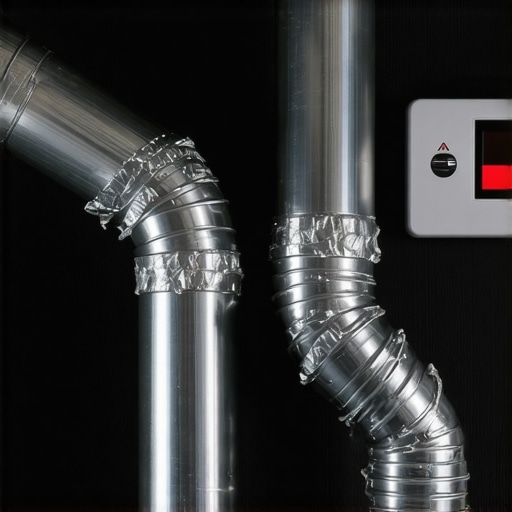
I’ve walked into commercial furnace repair jobs where the ‘handyman’ used duct tape—not even the good HVAC duct sealing mastic we call ‘pookie,’ but actual silver cloth tape—to seal a flue. Within a week, the adhesive dried out, the pipe slipped, and the kitchen staff was complaining of ‘flu-like symptoms.’ That’s not the flu; that’s the beginning of the end. Whether it’s a restaurant kitchen exhaust repair or a residential furnace, the physics of the venturi effect don’t care about your budget.
The Climate Factor: Why Northern Winters Are High Stakes
In the North, where the ‘Polar Vortex’ is a regular guest, the enemy is the ‘Ice Cap.’ During a deep freeze, a poorly insulated flue pipe will develop a frost layer at the termination point. As the furnace cycles, that frost grows until the pipe is completely choked. If your app-controlled heating systems aren’t integrated with a smart building management setup that monitors backdraft, the furnace might keep firing until the flame rollout switch trips—or worse, it doesn’t. Proper radiant floor heating installation often requires complex venting for high-efficiency boilers that DIYers simply aren’t equipped to handle. You can read more about common pitfalls in our furnace repair myths debunked guide.
[IMAGE_PLACEHOLDER]
The Math of Mortality: Repair vs. Disaster
A professional flue pipe installation might cost you $500 to $1,500 depending on the complexity and the need for a chimney liner installation. A DIY kit from a big-box store is $150. But here is the math a ‘sales tech’ won’t tell you: A cracked heat exchanger or a disconnected flue doesn’t just stop the heat; it fills your home with a gas that has 200 times the affinity for your hemoglobin than oxygen does. You don’t wake up from that. If you’re messing with solar thermal heating integration or trying to bypass a safety on a commercial furnace repair, you are playing with a loaded gun.
“Ventilating systems shall be designed and installed so that the draft is maintained within the range of pressure specified by the manufacturer.” – ASHRAE Standard 62.1
We see a lot of issues when people try to save money on HVAC duct sealing without looking at the return air. If your house is too tight (thanks to modern ‘energy efficiency’ standards) and you don’t have a dedicated combustion air intake, your furnace will actually pull air *down* the flue of your water heater to find oxygen. This is called backdrafting, and it’s a death sentence. It’s why you need a pro who understands the whole house as a single pressurized vessel. Check out our HVAC repair secrets for more on how these systems interact.
The Verdict: Professionalism vs. ‘The Hack’
If you see ‘pookie’ smeared on a flue pipe, or if you hear a ‘tink-tink-tink’ sound that isn’t just thermal expansion, you have a problem. If your wood burning stove installation doesn’t have the proper clearance to combustibles or the right gauge of pipe, you’re not just risking CO; you’re risking a structure fire. Even something as simple as a mini-split troubleshooting session often reveals that the backup heat source is venting improperly. You can see when to call us here: mini-split troubleshooting guide.
Don’t be the person who tries to save a few hundred bucks on a flue pipe installation only to end up as a cautionary tale in an HVAC training manual. Heat is a luxury, but breathing is a necessity. If you have any doubt about your venting, contact us immediately. We also recommend checking our ultimate guide to heat pump maintenance if you’re looking to move away from combustion-based heating altogether. Stay warm, stay safe, and for the love of all things mechanical, leave the tin knocking to the professionals.