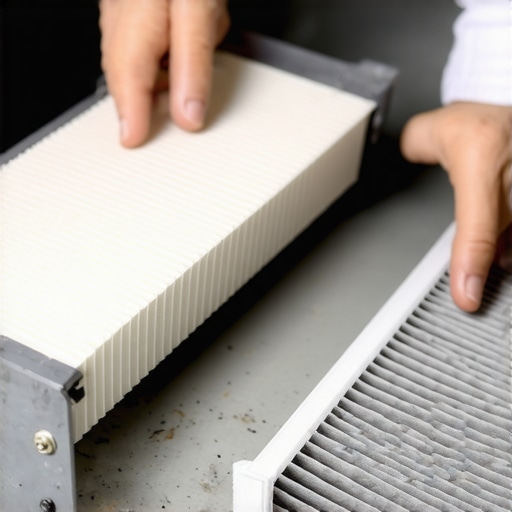
You think that 1-inch pleated filter from the big-box store is protecting your lungs. It is not. It is protecting the blower motor and the heat exchanger from becoming a fuzzy, matted mess of skin cells and pet dander. I have spent thirty years crawling through joists and melting on rooftops, and I am telling you: airflow is the lifeblood of your home’s thermal envelope. My old mentor, a grizzly guy who could smell a gas leak from the curb, used to scream at me in the middle of a frozen mechanical room in February, ‘You can’t cool what you can’t touch, and you can’t heat what won’t move!’ He was right. Most ‘broken’ furnaces are not actually broken; they are just suffocating under the weight of homeowner neglect.
The Physics of the Suffocating Blower
In our cold Northern climate, we deal with massive Delta-T requirements. When the wind is howling off the lake and it is -10°F, your furnace is working overtime to lift that air temperature to a comfortable 70°F. This process relies entirely on the heat exchanger. The gas burns, the metal gets hot, and the blower pushes return air over that metal. If your filter is clogged, the CFM (Cubic Feet per Minute) drops. This means the air stays in contact with the heat exchanger for too long. It gets dangerously hot. We are talking about reaching the metallurgical limit of the steel. This triggers the high-limit switch, causing the system to ‘short cycle.’ Eventually, that metal will crack. A cracked heat exchanger is not just a repair bill; it is a carbon monoxide death trap. This is why furnace repair myths often ignore the simplest truth: airflow determines the lifespan of your equipment.
“The most expensive equipment in the world cannot overcome a bad duct system.” – Industry Axiom
The MERV Filter Upgrade Trap
I see it every week. A homeowner wants ‘better air quality’ so they buy a high-MERV filter. They think they are doing a favor for their family, but without considering Total External Static Pressure (TESP), they are actually killing their blower motor. Slapping a MERV 13 filter into a duct system designed for a MERV 5 is like asking a marathon runner to breathe through a cocktail straw. If you have an old PSC motor, it will simply slow down, the coil will freeze (in AC mode) or the furnace will trip (in heat mode). If you have a modern ECM motor, it will ramp up its RPM to overcome the resistance, which makes your electric meter spin like a top. Before considering MERV filter upgrades, you need a tech to check your static pressure. Sometimes, the solution is not a thicker filter but duct cleaning services or a humidifier installation to manage the air density and comfort levels properly.
Commercial Stakes: From Churches to Kitchens
The physics do not change just because the building gets bigger. I have seen church heating systems fail during Christmas Eve services because the ‘maintenance guy’ forgot the filter bank in the crawlspace. In restaurant kitchen exhaust repair, the grease loading acts exactly like dust in a furnace—it creates resistance that the motor cannot overcome. For those managing larger properties, multi-family heating upgrades often fail to reach their promised efficiency because the existing ductwork is ‘Pookied’ shut or undersized for the new high-efficiency blowers. Whether you are looking at evaporative cooler services in the dry months or energy recovery ventilators to bring in fresh air without losing your heat, the fundamental law remains: the ‘gas’ or ‘juice’ in the system is useless if the tin knocker didn’t give the air a clear path to travel.
“Standard 62.1-2022: Ventilation and acceptable indoor air quality are dependent upon the continuous maintenance of filtration media and the integrity of the air distribution path.” – ASHRAE Standards
Why DIY Filter Changes Save Your Warranty
Most warranty service plans have a ‘fine print’ clause about proper maintenance. If I pull a blower motor that is burnt to a crisp and I see a filter that looks like a wool sweater, the manufacturer is going to deny that claim. You will be stuck paying full price for a part that should have been covered. This is where rebate application assistance won’t help you; no utility company gives money back for equipment killed by a $10 filter. If you’re feeling a room is too cold while others are hot, don’t just close the vents—that actually increases the pressure and makes the problem worse. Instead, look at the health of your return air drops and check your filter. If you are still having issues, it is time to look into hvac repair secrets that the sales techs won’t tell you. Real pros focus on the ‘beer can cold’ suction lines and the manifold pressure, not just trying to sell you a new box. If your furnace is screaming like a banshee, that screeching bearing is a direct result of the motor working too hard against a dirty filter. Stop skipping the simplest task in your house. Change the filter, or keep my number on speed dial, because you are going to need it when the heat exchanger finally gives up the ghost.
If you have ignored your system for too long, don’t wait for the ‘no heat’ call in a blizzard. Check out our ultimate guide to heat pump maintenance if you’re running a hybrid system, or just contact us to get a real tech out there who knows the difference between a real repair and a sales pitch.