The mercury is bottoming out at -10°F, the wind is howling through the eaves like a banshee, and your old furnace just gave its final, metallic death rattle. You’re sitting there in a parka, staring at a quote for a propane conversion versus a high-efficiency electric heat pump, and you’re wondering who’s lying to you. My old mentor, a guy who had forgotten more about thermodynamics than most ‘Sales Techs’ will ever learn, used to scream at me, ‘You can’t cool what you can’t touch, and you can’t heat what you don’t understand!’ He was right. Heating isn’t about adding ‘hot’ to a room; it’s about the brutal, uncompromising physics of energy transfer. Whether you’re burning gas or moving electrons, the house doesn’t care about your feelings—it only cares about the British Thermal Units (BTUs) you’re shoving into the space to counter the heat bleed through your walls. Choosing between propane and electric isn’t just a matter of the monthly bill; it’s a decision involving control board diagnostics, latent heat management, and the terrifying reality of upcoming refrigerant regulations. If you’re looking for a glossy sales pitch, go talk to a guy in a crisp white shirt who’s never seen the inside of a crawlspace. If you want the truth about what happens when the pookie hits the fan, keep reading.
The Thermodynamic Zoom: Propane’s Raw Power vs. Electric’s Finesse
When we talk about propane, we’re talking about fire. Specifically, we’re talking about the Annual Fuel Utilization Efficiency (AFUE) of a combustion process. A modern propane furnace can hit 96% AFUE, meaning 96 cents of every dollar you spend on ‘gas’ actually turns into heat for your home. But here’s the catch: propane is energy-dense. A single gallon of propane packs about 91,500 BTUs. In the frozen trenches of the North, where I’ve spent decades doing school boiler maintenance and keeping radiators from freezing solid, propane is the heavyweight champion for raw heat output. However, the ‘Sales Techs’ won’t tell you about the atmospheric variables. If your heat exchanger is cracked—a common death sentence I find during routine inspections—you aren’t just losing efficiency; you’re risking your life. This is why carbon monoxide detector installation isn’t an ‘upsell’—it’s a mandatory safety barrier for any combustion system. On the flip side, we have the electric heat pump and the increasingly popular mini-split systems. These don’t ‘create’ heat; they move it. Even at 0°F, there is heat energy in the outside air. A heat pump uses a compressor to squeeze that juice, raising the temperature of the refrigerant until it’s hot enough to warm your house. The efficiency here is measured in HSPF2 (Heating Seasonal Performance Factor). An electric system can technically be 300% efficient because it’s moving three units of heat for every one unit of electricity it consumes. But when the temp drops to the ‘Polar Vortex’ levels, that efficiency can tank, and you might find yourself relying on expensive ‘heat strips’ that eat your bank account alive.
“The most expensive equipment in the world cannot overcome a bad duct system.” – Industry Axiom
The Reality of Air Handler Repair and Static Pressure
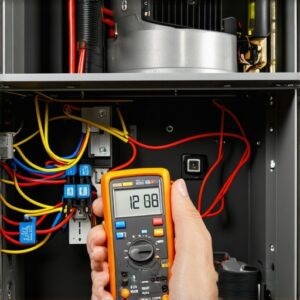
Whether you choose propane or electric, your air handler is the heart of the operation. I’ve seen brand-new, $15,000 systems strangled to death by a ‘tin knocker’ who didn’t understand static pressure. If your ductwork is too small, your blower motor will work twice as hard and die half as fast. During an air handler repair, I often find that the ‘performance’ issues aren’t mechanical; they’re architectural. If you’re converting from a boiler system (radiator replacement) to forced air, you’re looking at a massive overhaul. Propane furnaces need specialized venting (PVC for high-efficiency), while electric heat pumps require significant thermostat wiring upgrades and often a heavy-duty electrical panel upgrade. If you don’t account for the ‘Sparky’ (electrician) costs, your ‘cheap’ electric conversion just doubled in price. I always perform rigorous system performance testing before making a recommendation. We look at the Delta-T—the temperature difference between the return and supply air. If that air isn’t crossing the coil at the right velocity, you’re just wasting money, whether you’re burning propane or spinning a meter.
“Design heating loads shall be determined in accordance with the procedures described in the ASHRAE Handbook of Fundamentals or an equivalent method.” – ASHRAE Standard 90.1
The 2025 Regulatory Cliff: R-410A is Dead
Here is the part the brochures leave out. We are currently in the middle of the ‘A2L Transition.’ The EPA is phasing out R-410A refrigerant (the ‘gas’ inside your heat pump) because of its Global Warming Potential. By 2025, new systems will use R-454B or R-32, which are ‘mildly flammable.’ If you buy an old-stock R-410A electric system now, you might find that ‘topping off the juice’ in ten years will cost you a fortune. This regulatory shift is making propane look more attractive to some, as a furnace doesn’t rely on high-pressure refrigerant cycles to create heat. However, the cost of propane is volatile. It’s tied to oil prices. One year you’re paying $1.50 a gallon, the next you’re at $4.00. Electric rates tend to be more stable, but they are generally higher in the Northeast. If you’re considering a mini-split, you avoid the ductwork nightmare entirely, but you’re trading it for complex control board diagnostics if a sensor fails. I’ve seen ‘Sales Techs’ quote a whole new unit because they didn’t know how to test a $5 thermistor on an inverter board.
The Final Verdict: Maintenance and Longevity
I don’t care which one you choose; I care that it’s installed right and maintained properly. Propane systems require annual cleanings to prevent ‘sooting’ and to ensure the flame sensor isn’t coated in carbon. Electric systems need their coils washed and their condensate lines cleared of slime. If you’re the type of person who forgets to change a filter, you’re going to have a bad time regardless. This is why I advocate for priority service memberships. It’s not a ‘subscription’; it’s an insurance policy against a 2 AM breakdown in a blizzard. Whether it’s a baseboard heater repair or a full furnace swap, the math usually points to this: If you have natural gas, use it. If you’re stuck between propane and electric, look at your local utility rates and your home’s insulation. A leaky house will kill a heat pump’s efficiency, but it will also bleed a propane tank dry. Fix the envelope first, then worry about the equipment. And for the love of all that is holy, don’t let a ‘Sales Tech’ convince you that a bigger unit is better. Oversized units ‘short cycle,’ meaning they turn on and off so fast they never actually dehumidify the air or reach peak efficiency. It’s the fastest way to kill a compressor and leave you shivering. Physics doesn’t lie, even if the guy with the clipboard does.