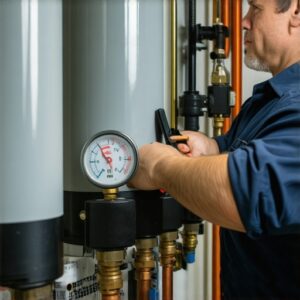

I remember my first week in the field, sweating through a heavy canvas jacket while my mentor, a guy who had been installing tin before I was born, grabbed my manifold gauges and threw them into the grass. He screamed, ‘You can’t cool what you can’t touch! This is why airflow matters more than horsepower!’ At the time, I thought he was just a cranky old salt, but thirty years of diagnosing short-cycling furnaces and frozen evaporator coils has proven him right every single time. Most homeowners think their comfort depends on the ‘juice’ or the size of the compressor outside, but the real magic—or the real failure—happens at the blower motor. If you have one room that feels like a meat locker and another that stays as stagnant as a swamp, your problem isn’t capacity; it is physics. Specifically, it is the inability of your old-school, single-speed motor to handle the static pressure of your ductwork.
The Airflow Manifesto: Why Static Pressure is Killing Your Comfort
In the trade, we have a name for the guys who just slap a new unit on a bad duct system: ‘Box Swappers.’ They do not care about the ‘Pookie’ (mastic) on the joints or the fact that your return air drop is three inches too small. They just want the sale. But here is the thermodynamic reality: if your air handler cannot overcome the resistance of your ducts, the heat exchange process fails. This is where variable speed blowers, or ECM (Electronically Commutated Motors), change the game. Unlike a standard PSC motor that is either 100% on or 100% off, an ECM motor adjusts its torque to maintain a constant CFM (cubic feet per minute). This is vital because, in the North where we deal with brutal winters, the density of the air changes, and a standard motor just can’t keep up, leading to those dreaded cold spots.
“The most expensive equipment in the world cannot overcome a bad duct system.” – Industry Axiom
When we talk about air handler repair, we are often dealing with motors that have burned out because they were fighting against a dirty filter or a restrictive duct design for a decade. A variable speed motor is smarter. It ‘feels’ the resistance and ramps up or down accordingly. This is the foundation of AI-driven HVAC optimization. By using sensors to monitor the load and the static pressure, these systems ensure that every corner of the house receives the exact amount of thermal energy required. If you are struggling with a bedroom that never stays warm, it might be time to stop looking at the thermostat and start looking at how the air is being pushed. Often, a boost in efficiency comes down to this precise control of air movement.
Thermodynamic Zooming: Latent Heat and the Dew Point
In a heating-heavy climate like the Northeast or Midwest, we also have to worry about the heat exchanger’s health. During a furnace tune-up service, I am looking for more than just a clean pilot light. I am looking at the temperature rise. If the blower isn’t moving enough air, the heat exchanger gets too hot, the metal expands and contracts violently, and eventually, it cracks. That is a one-way ticket to a carbon monoxide situation. Variable speed blowers allow the furnace to run for longer cycles at a lower capacity. This doesn’t just save gas; it keeps the heat exchanger at a stable temperature and ensures the air is mixed thoroughly throughout the home.
For those with steam boiler repair needs or baseboard heater repair, the logic is slightly different because you are dealing with radiation rather than forced air, but the principle of heat distribution remains. You can’t just throw BTU at a problem and hope it sticks. For air-based systems, though, the variable speed blower is the only way to manage the ‘sensible heat’ (the temperature you see on the wall) and the ‘latent heat’ (the moisture in the air). When the blower runs slower, the air spends more time in contact with the evaporator coil. In the summer, this allows the coil to drop below the dew point, effectively wringing the humidity out of the air like a sponge. This is why a variable speed system makes 75 degrees feel like 70, while a cheap single-speed unit leaves you in a cold, clammy mess.
“Standard 62.1 requires specific ventilation rates to maintain indoor air quality, which is virtually impossible to balance with fixed-speed equipment in varying loads.” – ASHRAE Standards
The Reality of Preventive Maintenance
I’ve seen too many ‘Sales Techs’ tell a customer they need a $20,000 system when a simple preventative maintenance contract could have saved their existing unit. During a real inspection, we check the ‘Sparky’s’ work (the electrical connections), ensure the capacitor isn’t bulging like a canned ham, and verify that the attic insulation for heating hasn’t been disturbed. If your insulation is thin, your variable speed blower will be working overtime to compensate for the heat loss through the ceiling. It is a holistic system. You can have the best air handler in the world, but if your attic is basically an open window, you are just heating the squirrels. This is why we emphasize debunking furnace repair myths; sometimes the fix isn’t a new motor, but better insulation or a cleared-out vent.
The Solution: From Mini-Splits to Boiler Services
If you have a room that is truly unreachable by your current ductwork, we often move away from the main air handler and suggest a ductless mini-split installation. These units are the kings of variable speed technology. Every mini-split is essentially a high-tech computer that manages refrigerant flow and fan speed in real-time. If you find yourself constantly using a space heater in a back office, you should know that portable heater safety checks are rarely performed, and those things are fire hazards. A permanent solution like a mini-split or even a boiler repair service to fix a cold radiator is a much safer bet. If your mini-split is acting up, you can check out this troubleshooting guide before you call the pros.
Ultimately, ending hot and cold spots isn’t about more power; it’s about smarter delivery. Whether it’s through furnace tune-up services, fixing the baseboard heater repair issues in the basement, or upgrading to a variable-speed air handler, the goal is consistent airflow. Do not let a box-swapper tell you otherwise. If they don’t pull out a manometer to check your static pressure, they aren’t fixing your problem—they are just selling you a new one. For any questions or a real diagnosis, feel free to contact us and talk to someone who actually knows how to read a psychrometric chart.