The Sound of Silence: A Cold Reality in Mid-Winter
It is 3:00 AM in the middle of a February cold snap. The silence in your house isn’t the peaceful kind—it is the heavy, oppressive silence of a furnace that has decided to quit. Before you panic and pay a 3x holiday-rate ‘Sales Tech’ to come out and tell you that your whole system is shot, you need to understand the mechanical anatomy of your heating system. Most ’emergency’ calls are the result of basic physics failing due to lack of maintenance, not catastrophic mechanical failure. My old mentor, Big Lou, used to scream at me over the roar of a 500,000 BTU hotel boiler, ‘You can’t heat what you can’t touch!’ He was talking about the boundary layer of air on a heat exchanger, but the lesson was broader: if the physics of airflow and combustion are not respected, the system will lock itself out to prevent a house fire or a carbon monoxide event.
“The most expensive equipment in the world cannot overcome a bad duct system.” – Industry Axiom
1. The Invisible Guardian: Furnace Flame Sensor Cleaning
If your furnace kicks on, the igniter glows cherry red, you hear the whoosh of gas, and then everything shuts down after five seconds, you aren’t looking at a dead compressor or a fried control board. You are looking at a dirty flame sensor. This is a simple rod of stainless steel that sits in the path of the flame. Through a process called flame rectification, the furnace control board sends an AC current to the sensor, which the flame then converts to a DC micro-amp signal. If that sensor is coated in microscopic carbon soot or silica from a nearby steam humidifier, the signal won’t reach the board. The board thinks no flame exists and shuts the gas valve to prevent your basement from becoming a bomb. Before calling for HVAC repair, a quick rub with a piece of Scotch-Brite (never sandpaper, which leaves grit) can save you a $300 service call. This is basic control board diagnostics that any ‘Tin Knocker’ worth his salt knows by heart.
2. The Thermodynamic Chokehold: Airflow and Heat Exchangers
Airflow is the lifeblood of any system, whether it is a residential wall furnace installation or a complex dual fuel heat pump system. When you ignore your filter, the static pressure in your air handler rises. As the blower motor struggles against this resistance, the temperature inside the heat exchanger skyrockets. In a cold climate like Chicago or the Northeast, this causes the metal to expand and contract too violently. Eventually, the metal fatigues and cracks. A cracked heat exchanger isn’t just a repair issue; it is a life-safety issue.
“Any breach in the heat exchanger of a category I furnace is grounds for immediate decommissioning of the appliance.” – NFPA 54 / ANSI Z223.1
If you smell a faint, metallic tang or a sweet, sickly odor, shut the gas off immediately. However, if the unit is just ‘tripping’ on the high-limit switch, check your return air drops. If you have closed too many vents to ‘save energy,’ you are actually killing your heat exchanger by starving it of the air it needs to stay cool enough to function. For more on this, see our furnace repair myths debunked guide.
[IMAGE_PLACEHOLDER]
3. The Brain and the Sparky: Control Board Diagnostics
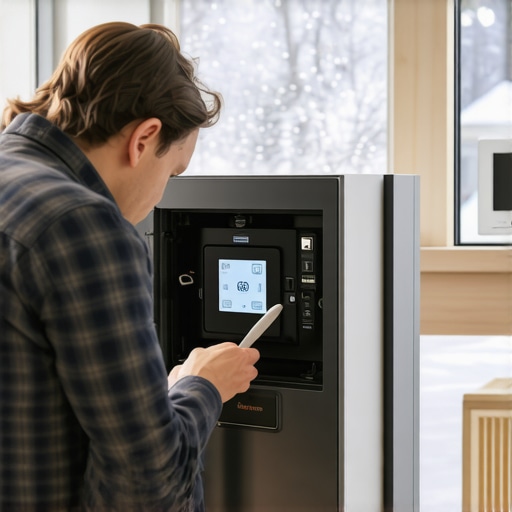
Before you call for a professional, look through the little peep-hole on your furnace’s blower door. You’ll see a blinking LED light. That isn’t just decoration; it’s the unit’s way of talking to you. Those blinks are a Morse code for HVAC techs. Three blinks might mean a pressure switch failure; five blinks might mean a primary limit lockout. If the light is off entirely, check your breaker. I once drove two hours to a remote job site only to find that a ‘Sparky’ (electrician) had tripped the furnace breaker while installing a new outlet. If you have a dual fuel heat pump system, the logic is even more complex. The system has to decide when to use the electric heat pump and when to switch to gas based on the ‘balance point’ of the outdoor temperature. If your outdoor unit is encased in a block of ice because the defrost cycle failed, the indoor unit will struggle. You can find troubleshooting steps for these scenarios in our ultimate guide to heat pump maintenance.
4. Fuel and Fire: Gas Supply and Steam Humidifiers
It sounds insulting, but check the gas valve. Often, during other home repairs, the gas to the furnace is bumped or shut off. If you have a wall furnace or a unit in a tight closet, the vibration can sometimes cause old valves to settle. Furthermore, if you have a steam humidifier integrated into your ductwork, ensure it isn’t leaking moisture back into the burner assembly. Moisture in the combustion chamber leads to rapid corrosion and ‘pitting’ of the burners. If the gas is on and the igniter isn’t even glowing, you might be looking at a bad inducer motor—the small fan that clears the ‘gas’ (exhaust) out of the flue before ignition. If that motor doesn’t reach the required RPM, the pressure switch won’t close, and the whole sequence of operation halts. This is the ‘Forensic Diagnosis’—finding the one broken link in the chain of events that leads to fire.
When DIY Ends and the Pro Begins
If you’ve checked the flame sensor, verified the breaker isn’t tripped, replaced the filter, and read the blink codes, and the house is still dropping toward 50°F, it’s time to call a pro. Don’t let a ‘Sales Tech’ talk you into a $20,000 full-system replacement just because an inducer motor died. If you are dealing with large-scale equipment like hotel boiler services or complex zoning system installation, the physics of water and air require specialized tools like manometers and combustion analyzers. Comfort is physics, not magic. Whether it is an air handler repair or a simple cleaning, the goal is always to restore the thermodynamic balance. If you’re stuck, contact us for a real technician who cares about airflow, not just a commission check.