The Ghost of Comfort Past: Why Your Feet Are Still Freezing
My old mentor, a man who had more soot in his lungs than a 19th-century chimney sweep, used to scream at me whenever I’d miscalculate a heat load. ‘Listen here, kid,’ he’d bark, grabbing my shoulder with a hand that felt like sandpaper, ‘You can’t heat what you can’t touch! This isn’t magic; it’s physics. If the floor is cold, the bones are cold.’ He was a purist who believed that the only real way to heat a home was to mimic the sun—radiant energy. He wasn’t wrong. Most homeowners think heating is just blowing hot air through some tin, but that’s like trying to warm up a cold steak by breathing on it. In the frigid North, where a polar vortex can turn your pipes into ice pops, radiant floor heating is the gold standard, but only if you follow the laws of thermodynamics.
As we barrel toward 2026, the rules of the game have changed. We aren’t just throwing some PEX pipe in a slab and calling it a day anymore. Between SEER2 compliant upgrades affecting how we look at total home efficiency and the shift toward electrification, installing a radiant system requires more than just a sparky to wire a pump. It requires an understanding of mean radiant temperature and thermal mass. If you’re tired of wearing three pairs of wool socks in your own living room, listen up. Here are the five hard rules for radiant floor heating installation in the coming years.
Rule 1: The Thermal Barrier—Stop Heating the Worms
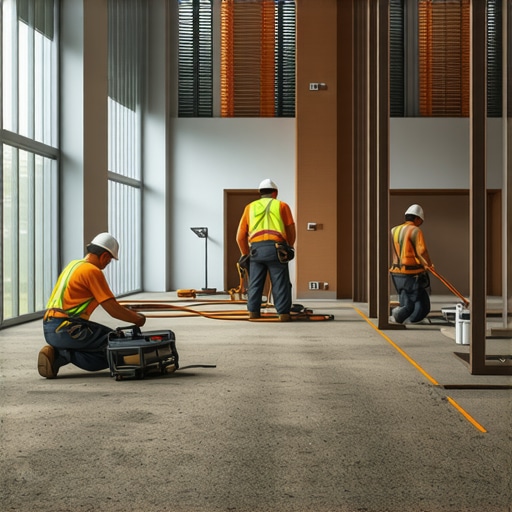
The biggest mistake I see ‘Sales Techs’ make is failing to account for downward heat loss. Heat doesn’t just rise; it moves toward cold. If you put a radiant system over an uninsulated slab, you are effectively trying to heat the entire crust of the Earth. You’ll spend thousands on furnace repair services or boiler fuel just to keep the worms under your house cozy while your toes stay blue. For 2026, you need a minimum of R-10 rigid foam insulation under any slab-on-grade installation. This forces the energy upward into the finished floor. Without it, your system will be constantly ‘hunting’ for a setpoint it can never reach, leading to premature transformer replacement because the controls are cycling until they melt.
“Thermal comfort is that condition of mind that expresses satisfaction with the thermal environment and is assessed by subjective evaluation.” – ASHRAE Standard 55
Rule 2: Hydraulic Balancing and the Myth of ‘One Size Fits All’
I’ve walked into too many jobs where a tin knocker tried to play plumber and ended up with loops that were 500 feet long. Fluid, like a lazy teenager, takes the path of least resistance. If one loop is shorter than the others, that room will be a sauna while the rest of the house feels like a meat locker. In 2026, we use manifold actuators and flow meters to dial in the GPM (gallons per minute) for every single circuit. This isn’t a wall furnace installation where you just flip a switch; it’s a balanced ecosystem. If the flow is wrong, the latent heat transfer fails, and you’ll find yourself calling for baseboard heater repair just to supplement a system that should have worked in the first place.
Rule 3: The Integration of SEER2 and Heat Pump Technology
The 2023 SEER2 mandates were just the beginning. By 2026, the integration of air-to-water heat pumps with radiant floors will be the standard for high-efficiency homes. These systems don’t use ‘gas’ (refrigerant) to heat the air directly; they use it to move heat into a buffer tank. If you’re still relying on an old-school boiler without a chimney liner installation, you’re burning money. Modern systems require a low-temperature delivery. Radiant floors are perfect for this because they only need 90°F to 110°F water, whereas a radiator replacement usually demands 160°F or higher. Lowering that temperature increases the life of your equipment and prevents the acidic burnout smell of a compressor pushed too hard. For more on high-efficiency transitions, check out the ultimate guide to heat pump maintenance and repairs.
Rule 4: Don’t Ignore the Air (Duct Cleaning and Ventilation)
Wait, why talk about ducts in a radiant floor article? Because even the best radiant system doesn’t provide cooling or fresh air filtration. In 2026, the smartest homes use a hybrid approach. You have your radiant floors for ‘sensible heat’ (the heat you feel) and a dedicated outdoor air system (DOAS) for ‘latent heat’ (humidity control) and filtration. If those ducts are filled with construction dust from your remodel, your air quality will suffer even if your feet are warm. This is where duct cleaning services become mandatory. You don’t want to be the guy with warm feet and a constant cough. Maintaining that secondary system is vital; you can see how to avoid common pitfalls in this expert tips guide.
“The most expensive equipment in the world cannot overcome a bad duct system or poor hydronic design.” – Industry Axiom
Rule 5: Preventive Maintenance—The Death of the ‘Set and Forget’ Mentality
The ‘Sales Techs’ will tell you radiant is maintenance-free. They’re lying. The fluid in your floor (the ‘juice’) can become acidic or grow biological sludge over time. Without a yearly furnace tune-up services equivalent for your hydronic system—which includes checking the pH of the glycol and testing the expansion tank—you’re asking for a massive headache. If your pump dies on a Sunday night because the fluid was too thick, a simple pellet stove repair or furnace repair services won’t save you. You need a tech who knows how to flush a loop without air-locking the whole house. If you suspect your system is underperforming, don’t wait for a total freeze-up; look into furnace repair myths to see what actually matters when things go wrong.
The Bottom Line: Physics Wins Every Time
Whether you’re dealing with a pellet stove repair in the garage or a full-scale radiant install in a 5,000-square-foot custom build, the physics of heat transfer remain the same. You need proper insulation, balanced flow, and integrated controls. In 2026, we don’t have room for error. Energy costs are too high, and the equipment is too sophisticated for ‘handyman’ fixes. If your current tech doesn’t know what a ‘microbubble resorber’ is, it’s time to contact us and get a pro on the job. Don’t let your home become a cautionary tale of bad airflow and cold slabs. For more information on how we handle your data, see our privacy policy. If you are having trouble with smaller systems, our mini-split troubleshooting guide might be the quick fix you need. Keep your feet warm, keep your ‘gas’ charged, and never trust a tech who doesn’t carry a manometer.