The Sound of a Cold House: Why the First Hour of a Breakdown is the Most Expensive
It is 3:00 AM on a Tuesday in mid-January. The temperature outside is hovering at a bone-chilling 4°F. You wake up not because of an alarm, but because of the silence. That rhythmic, low-frequency hum of your furnace or heat pump has vanished. In its place is the sound of your pipes beginning to contract and the realization that your sanctuary is losing its thermal envelope at a rate of three degrees per hour. This is where most homeowners panic. They call the first number on Google, and more often than not, they get a ‘Sales Tech’—a guy in a crisp white shirt who hasn’t seen the inside of a combustion chamber in five years and carries a clipboard instead of a multimeter.
The $14,000 Ghost: A Lesson in Technical Integrity
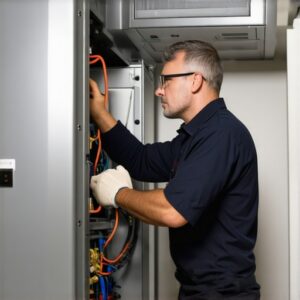
I remember following one of these ‘clipboard commandos’ out to a job last winter. He’d told a young couple their secondary heat exchanger was ‘compromised’ and the unit was leaking carbon monoxide. He’d red-tagged the furnace, shut off the gas, and handed them a quote for $14,000 for a full system replacement. When I arrived for a second opinion, I didn’t look at the sales brochure. I pulled the inducer motor and used a borescope. The ‘crack’ he’d shown them on a grainy tablet screen was actually just a streak of dried condensate minerals. The real culprit? A pitted contactor and a flame sensor so fouled with silica that it couldn’t rectify the microamp signal back to the control board. A contactor repair and a professional heat exchanger cleaning cost them a few hundred bucks, not fourteen grand. That is the difference between a technician and a salesman. This is why our service membership isn’t a ‘subscription’—it’s an insurance policy against predatory diagnostics.
“The most expensive equipment in the world cannot overcome a bad duct system or a lack of verifiable maintenance.” – Industry Axiom
Thermodynamics Don’t Care About Your Budget
To understand why a membership pays for itself, you have to understand the physics of a heat pump or furnace. We aren’t just ‘blowing hot air.’ We are managing a complex exchange of BTUs. In a heating cycle, your evaporator coil (which is now acting as a condenser) must reach a specific temperature to overcome the sensible heat of the return air. If your airflow is restricted because you haven’t had duct cleaning services in five years, the static pressure rises. High static pressure is the silent killer of compressors. It’s like trying to breathe through a straw while running a marathon. When we perform HVAC load calculation services, we aren’t just guessing; we are measuring the exact volume of air required to move those BTUs efficiently without frying the windings in your blower motor.
The Anatomy of a Breakdown: Why Parts Fail
Let’s talk about refrigerant leak detection. Most guys want to just ‘top off the gas.’ In this industry, we call it ‘juicing the system.’ But refrigerant doesn’t evaporate; it’s a sealed loop. If you’re low on juice, you have a hole. Adding gas without finding the leak is like trying to fill a bucket with a hole in the bottom. Our members get comprehensive leak checks because an undercharged system causes the suction line to drop below the dew point, leading to a frozen coil and, eventually, liquid slugging that destroys the compressor valves. If you’ve ever heard a compressor ‘screech’ on startup, that’s the sound of metal-on-metal because the oil has been washed away by liquid refrigerant.
Water, Steam, and the North Climate Battle
In our region, the air gets so dry in winter it literally sucks the moisture out of your skin and your wood floors. That’s where steam humidifiers come in. Unlike those old bypass pads that grow mold and scale, a steam unit injects pure vapor into the airstream. But steam means boiling water, and boiling water means mineral buildup. A membership ensures that your humidifier doesn’t turn into a block of calcium by mid-February. And let’s not forget the hot water heater repair side of things. Whether it’s a standard tank or a tankless unit, the ‘Sparky’ (electrician) and the ‘Tin Knocker’ (duct guy) both know that scale is the enemy of efficiency. We flush those tanks to ensure you aren’t heating fifty gallons of sediment before you heat the water.
“Properly maintaining HVAC systems can reduce energy consumption by 5% to 40% depending on the system’s age and condition.” – ASHRAE Standard 180
The Digital Defense: Geofencing and Remote Access
Modern comfort isn’t just about mechanical parts; it’s about logic boards. We integrate geofencing temperature control and remote thermostat access into our maintenance protocols. Why? Because if your furnace fails while you’re on vacation in Florida, you need an alert on your phone before your pipes burst. We calibrate these sensors during every visit. We ensure the algorithms that drive your variable speed motor are actually communicating with the outdoor ambient sensor. If your ‘Smart’ thermostat is wired incorrectly, it might be calling for ‘Aux Heat’ (electric heat strips) unnecessarily, which is essentially like turning on a giant toaster in your attic and watching your electric bill triple.
The Math of the Membership
How does it pay for itself? Simple. A standard emergency diagnostic fee, a 20% discount on that contactor repair we mentioned, and the 15% savings on duct cleaning services already puts you in the black. Add in the fact that a clean heat exchanger and calibrated gas pressure can save you $30 a month on your utility bill, and the membership isn’t an expense—it’s a profit center for your household budget. Don’t fall for the furnace repair myths spread by guys trying to sell you a new unit every ten years. A well-maintained machine can last twenty if you treat it right. If you want to see how we handle these high-performance systems, check out our ultimate guide to heat pump maintenance. We don’t use ‘Pookie’ (mastic) to hide problems; we use tools to fix them. Stop waiting for the silence of a cold house. Contact us today to get your system on a professional regimen.