
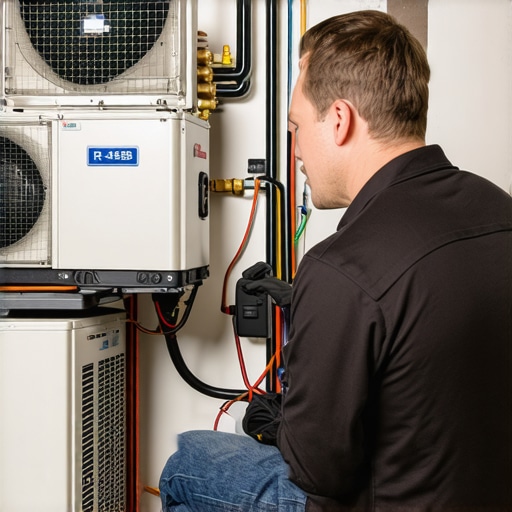
The Great Refrigerant Reckoning of 2025
Listen, I’ve spent three decades crawl-spacing through spider webs and roasting on tar-paper roofs in the middle of July. I’ve seen R-12 go the way of the dinosaur and R-22 become more expensive than a vintage bottle of scotch. But the shift we’re seeing right now—the mandated transition to A2L refrigerants like R-454B—is the biggest shake-up I’ve seen since we swapped out mechanical thermostats for digital ones. If you think your next cooling service call is going to be business as usual, you’re in for a wake-up call that’s going to hit your wallet and your comfort levels simultaneously.
Last week, I followed a ‘Sales Tech’—you know the type, clean uniform, shiny clipboard, zero grease under his fingernails—who had just quoted a retired schoolteacher sixteen grand for a full system replacement. His reason? He told her that because her R-410A unit had a small leak in the evaporator coil, it was ‘illegal’ to repair because of the new EPA regulations. Total garbage. I walked in, found the leak at a brazed joint that just needed a little silver solder, and checked her capacitor. She didn’t need a new system; she needed a tech who wasn’t chasing a commission. But this scenario is becoming more common as the industry pivots toward R-454B. These guys use the regulatory confusion to scare homeowners into buying equipment they don’t yet need. Understanding the physics of HVAC repair during this transition is the only way you won’t get taken for a ride.
“The most expensive equipment in the world cannot overcome a bad duct system.” – Industry Axiom
Thermodynamics and the A2L Shift: Why R-454B Matters
Let’s talk shop for a second. R-410A, the gas we’ve used for twenty years, is being phased out because its Global Warming Potential (GWP) is too high. Enter R-454B. It’s an A2L refrigerant, which is engineering-speak for ‘mildly flammable.’ Now, don’t panic—your AC isn’t going to turn into a Roman candle—but the physics are different. R-454B has a lower discharge temperature and a different pressure-temperature relationship. This means that if you’re used to the old days of a guy just hooking up gauges and adding ‘a little juice,’ those days are dead. The charging tolerances on these new systems are razor-thin. If the charge is off by even a few ounces, the subcooling won’t be right, the latent heat removal—that’s the humidity, for those of you not wearing work boots—will suffer, and you’ll be left with a house that feels like a cold, damp basement.
Because R-454B is mildly flammable, the new equipment comes packed with ‘leak detector integration.’ These aren’t your standard sensors; they are safety-critical components that can shut the whole system down if they detect a whiff of gas in the indoor coil cabinet. If your tech doesn’t understand how to calibrate these during a capacitor replacement services call or a standard tune-up, your system will lockout, and you’ll be sitting in 95-degree heat while the ‘Sparky’ tries to figure out why the control board is flashing a red code. This is why hvac repair secrets boost efficiency with expert tips are more relevant now than ever. You need a tech who understands the sensors, not just the wrenches.
The Ductwork Crisis: You Can’t Cool What You Can’t Touch
I tell every apprentice I’ve ever trained: airflow is king. You can put a 20-SEER variable-speed R-454B compressor in a house, but if the ductwork was designed by a ‘tin knocker’ who was having a bad day in 1985, that unit is going to die a premature death. These new systems operate at higher static pressures. If your return air drop is too small, the evaporator coil will drop below the dew point too quickly, it’ll freeze up, and you’ll be calling for contacting us for an emergency repair before the first summer is over. This is where duct design services become the bridge between a system that works and one that just eats money. Most ‘Sales Techs’ won’t even look at your ducts; they just want to swap the box and move to the next lead.
“Designers shall use Manual J for load calculations and Manual D for duct design to ensure equipment longevity and occupant comfort.” – ACCA Standard 5
If you’re in a mixed climate—where you’re running furnace repair diagnostics in the winter and cooling in the summer—the transition is even trickier. Many homeowners are looking at geothermal heat pump systems or propane conversion services as alternatives to traditional electric cooling. But whether you’re burning gas or moving refrigerant, the principle of heat transfer remains the same. You are moving BTUs from where they aren’t wanted to where they don’t matter. When we do a smart thermostat setup or voice control setup Alexa Google, it’s not just for convenience; it’s to monitor the delta-T (the temperature difference) across the coil. If that delta-T isn’t 18 to 22 degrees, your system is failing you, even if it’s ‘running.’
The Real Cost of the Transition
The 2025 mandate means that manufacturing of R-410A units is stopping. This is driving a ‘gold rush’ where contractors are marking up existing stock or overcharging for the new A2L units because they require ‘specialized tools.’ While it’s true we need spark-proof vacuum pumps and recovery machines now, that shouldn’t mean a 40% markup for the homeowner. When I’m out on a call for ventless gas heater services or a standard AC leak search, I see the fear in people’s eyes. They’ve heard the rumors. But here’s the truth: your existing R-410A system can be repaired for years to come. Don’t let a tech tell you that a bad fan motor or a failed contactor means you need a whole new R-454B system. You can check out furnace repair myths debunked to see how similar ‘scare tactics’ are used in the heating side of the business.
The move to R-454B actually offers an opportunity for those who do it right. The newer compressors are more efficient at handling sensible heat—that’s the actual temperature on the thermometer. But in humid climates, we have to be careful about short-cycling. If the unit is oversized (which 80% of them are because techs are too lazy to do a Manual J load calc), it will cool the air so fast that it doesn’t have time to pull the water out of it. You’ll end up with 72 degrees and 70% humidity. That’s not comfort; that’s a petri dish for mold. If you’re struggling with these issues, refer to our ultimate guide to heat pump maintenance and repairs for a breakdown of how to maintain that critical balance.
The Forensic Diagnosis: Knowing When to Fold ‘Em
So, how do you decide between a repair and a replacement in this new R-454B era? It comes down to the ‘Mechanical Anatomy’ of your system. If your compressor’s windings are grounded—meaning you have a ‘burnout’—the acid in the system is going to make any repair a gamble. You’ll smell it immediately; it’s a sour, acidic stench that stays in your nostrils for days. In that case, with the refrigerant transition looming, a new system makes sense. But if it’s a leak in a 10-year-old coil? We can often fix that, or replace the coil and keep the R-410A condenser running. Don’t let a ‘Sales Tech’ bully you into the 2025 transition before you’re ready. However, if you do decide to upgrade, make sure you’re looking at the total package, including leak detector integration and ensuring your smart thermostat setup is compatible with the new A2L boards. If you have a mini-split system, the logic is even more sensitive, as I’ve detailed in mini split troubleshooting when and how to call a pro.
Ultimately, the R-454B transition is just another chapter in the book of thermodynamics. The gas changes, the pressures shift, and the sensors get smarter, but the goal remains the same: moving heat. Whether you’re dealing with ventless gas heater services in the dead of winter or a high-pressure cutout in the heat of July, demand a tech who knows the physics, not just the price book. Airflow is king, the ‘Suction Line’ should be ‘beer can cold,’ and ‘Pookie’ is still better than silver tape for sealing a plenum. Keep your coils clean, your filters changed, and don’t believe everything a guy with a clean shirt tells you.