
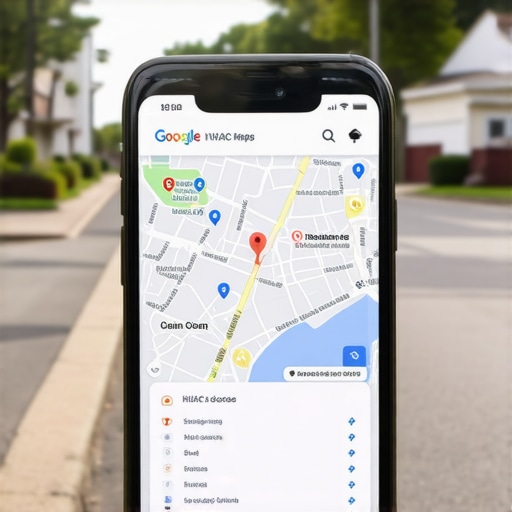
How to See Exactly Where Homeowners Find Your HVAC Business on Google Maps
Imagine this: You’ve spent years building your HVAC business. You have a fleet of clean vans, a team of NATE-certified technicians, and a Google Business Profile (GBP) with a 4.9-star rating and over 200 glowing reviews. On paper, you are the king of your city. Yet, when you look at your call logs, there is a glaring hole. You aren’t getting any furnace repair calls from the wealthy suburb just five miles north of your shop – a neighborhood where homeowners have high disposable income and aging HVAC systems.
You search “AC repair near me” while sitting at your office desk, and there you are: Number One. You assume you’re dominating the market. But that single search result is a dangerous lie. In the world of local search, your “rank” isn’t a single number; it’s a moving target that changes every few blocks. This is the “Blind Spot” of HVAC marketing, and it’s likely costing you thousands of dollars in lost service calls every month.
To win in 2026, you need to understand the Local Map Pack. These are the three businesses that appear at the top of Google Maps when a homeowner searches for a service. Statistics show that the top three results capture over 70% of the clicks. If you aren’t in that top three in a specific neighborhood, you effectively don’t exist to those homeowners. To bridge this gap, you must learn How to Check if Your HVAC Company Is Actually Ranking in Nearby Neighborhoods using visual data rather than guesswork.
What is a GeoGrid and Why Does Your HVAC Shop Need One?
Traditional SEO tools were built for national brands. They tell you that you rank #4 for “HVAC installation” in Chicago. But Chicago is massive. Ranking #4 in a city of millions is meaningless if you’re #1 in the industrial district where no one lives and #20 in the residential suburbs where everyone needs your help. This is where GeoGrid technology changes the game.
A GeoGrid is a visual representation of your local search rankings. Instead of a single data point, it places a virtual grid (often 5×5 or 11×11) over a map of your service area. The tool then performs a search at every single intersection point on that grid. The result is a heatmap of numbers. A “1” in a green circle means you are the top result at that exact spot. A “15” in a red circle means you are buried on page two or three of the maps results.
The core of this technology revolves around three pillars: Proximity, Relevance, and Prominence. While you might have high relevance (great keywords) and prominence (lots of reviews), Google’s algorithm weighs proximity – the physical distance between the searcher and your business – extremely heavily. Using a google maps rank tracker allows you to see exactly where your “Proximity Wall” is. You might rank #1 at your office, but the moment a homeowner crosses a major highway or enters a different zip code, your ranking might plummet. Understanding this allows you to stop guessing and start targeting your marketing efforts where they are actually needed.
The Top Tools to Visualize Your Local Reach
If you want to dominate your service area, you need the right local seo software. In the HVAC industry, where competition is fierce and the cost-per-click for Google Ads can exceed $100, organic map visibility is your most valuable asset. Several tools have become industry standards for visualizing the Local Pack.
- SEO Viper Tools: Known for its precision and ease of use, this tool provides a comprehensive google business profile seo suite that helps contractors visualize their reach instantly.
- MapRanking.com: This platform offers incredibly detailed grid reports that allow you to track your progress over time. You can see if your recent optimization efforts are actually turning “red” zones into “green” ones.
- Grid My Business: An AI-powered tracker that not only shows you where you rank but also compares your performance directly against your top three competitors at every grid point.
- Local Falcon: One of the pioneers of GeoGrid technology, offering a highly visual interface that is perfect for presenting ROI to stakeholders.
Expert local SEO strategist Heide Bautista often emphasizes the importance of these visuals. “I help plumbers, HVAC companies, and roofers get more calls by turning ‘red’ grid points into ‘green’ ones,” Bautista explains. “The map doesn’t lie. When a business owner sees a sea of red circles over their most profitable neighborhood, they finally understand why the phone isn’t ringing, despite their five-star reputation.” To see the exact stack of resources we recommend, check out The free maps tools we use to grow our local service footprint.
Step-by-Step: How to Run Your First Map Audit
Ready to see the truth about your visibility? Performing a map audit is a technical but straightforward process. Follow these steps to identify your blind spots using a google business profile optimization tool.
Step 1: Choose Your Primary Keywords
Don’t just search for “HVAC.” Homeowners use specific, high-intent keywords. Run audits for “AC repair [City],” “furnace installation,” and “emergency HVAC service.” Each of these keywords may produce a completely different GeoGrid result.
Step 2: Set Your Grid Size and Radius
For most HVAC companies, a 13×13 grid covering a 10-mile radius is a good starting point. This provides enough granularity to see how your rankings change from one neighborhood to the next. If you are in a densely populated urban area, you may want to shrink the radius to 5 miles but keep the grid points high.
Step 3: Identify the “Red Zones”
Once the report runs, look for patterns. Are you “green” only in a small circle around your physical office? This is a sign that your Authority is low, and Google is only showing you to people who are physically very close. Are you “green” in the north but “red” in the south? There may be a competitor in the south with better local signals or more localized content.
Step 4: Analyze the Competition
Most GeoGrid tools allow you to click on a red point to see who is ranking in the top three. Look at their profiles. Do they have more photos? Do they mention the specific neighborhood in their description? This competitive intelligence is the “low-hanging fruit” of local map pack seo.
Turning Data into Service Calls: Optimization Strategies
Seeing the red circles is only the beginning. The goal is to rank google business profile locations in those underserved areas. To do this, you need a multi-pronged approach that moves beyond basic NAP (Name, Address, Phone number) consistency.
Hyperlocal Content Strategy
If you want to rank in “Oak Creek Estates,” you need to tell Google that you are an expert in that specific area. This is where How Hyperlocal Pages Bring in More HVAC Customers From Your Specific City becomes a vital part of your strategy. Create pages on your website dedicated to specific neighborhoods, detailing common HVAC issues found in those types of homes (e.g., “Common AC problems in Oak Creek’s 1990s-era split-levels”).
Mastering Local Schema Markup
Search engines need structured data to understand the geographic context of your business. Implementing google maps ranking service best practices involves using local business schema. This code tells Google exactly which areas you serve, your office hours, and your specific service offerings. Read more on Why local schema markup is the secret to winning local HVAC search to understand the technical implementation.
The Power of Geo-Targeted Signals
To expand your green zones, you must generate signals from those specific locations. Encourage your technicians to take “check-in” photos using tools that geotag the image to the customer’s neighborhood. When you upload a photo of a new furnace installation to your GBP, and that photo is metadata-tagged to a specific suburb, Google begins to associate your business with that location. This is a core component of local seo tools usage today.
Furthermore, you should implement these 7 Google Business Profile Moves That Get More Eyes on Your HVAC Service Van to ensure your profile is fully leveraged for maximum reach.
2026 Trends: The Future of Google Maps for Contractors
The landscape of local search is shifting rapidly. As we head into 2026, the reliance on AI and voice search is changing how homeowners find HVAC services. When someone tells their AI assistant, “Find the best AC repair near me,” the AI isn’t browsing a list of 20 businesses. It is picking the one it deems most relevant based on proximity and real-time data.
We are seeing a shift where “near me” searches are becoming even more hyper-localized. Google’s “Search Generative Experience” (SGE) is now pulling data from reviews and website content to answer specific queries like “Who is the best HVAC company for Lennox repairs in the Westside district?” If your data isn’t visualized and optimized for these micro-locations, you will lose out to smaller, more agile competitors. Stay ahead by understanding Why Local SEO Trends in 2026 Are Shifting How Homeowners Book Furnace Repairs.
Conclusion: Stop Guessing and Start Dominating
In the HVAC industry, visibility is the difference between a fully booked schedule and a quiet shop with bored technicians. If you cannot see exactly where your rankings stand, you cannot hope to improve them. Traditional rank tracking is a relic of the past; GeoGrid technology is the present and future of local dominance.
By identifying your “Red Zones,” analyzing your competitors, and implementing hyperlocal SEO strategies, you can expand your reach into the neighborhoods that matter most. Don’t let your competitors hide in your blind spots. Audit your profile today, visualize your data, and take control of your local market.
Ready to turn your map green and get more calls? Contact Us today for a professional audit of your Google Business Profile and a custom strategy to dominate your service area.
About the Author: Heide Bautista is a leading expert in local search optimization. She specializes in helping plumbers, HVAC companies, roofers, and other home service businesses get more calls from Google Maps and Google search by leveraging advanced Google Business Profile strategies and GeoGrid technology.