The Radiant Heat Trap: Why Your Walls Are at Risk
I’ve spent thirty winters crawling through crawlspaces and balancing on pitched roofs, and if there is one thing I’ve learned, it’s that radiant heat is a patient killer. Most homeowners think a wood stove installation is as simple as plopping a cast-iron box on a hearth and shoving a pipe through the ceiling. That’s how you end up meeting the fire department at 3 AM. When we talk about wood burning stove installation, we aren’t just talking about aesthetics; we are talking about the physics of pyrolysis. This isn’t some sales-pitch nonsense where I try to upsell you on a Wi-Fi thermostat. This is about the thermodynamic reality that wood—specifically the framing inside your walls—lowers its ignition temperature every time it gets baked by a stove that’s too close. Over years, those studs dry out until they can catch fire at temperatures lower than a pizza oven.
The Physics Lesson: Why Airflow Dictates Safety
My old mentor, a grizzled tin knocker who could bend 24-gauge steel with his bare hands, used to scream at me, ‘You can’t heat what you can’t touch!’ He wasn’t just talking about convective loops. He was obsessed with the idea that air is the greatest insulator we have—if you keep it moving. In the North, where the polar vortex turns your lubricants into molasses, we rely on high-output heat. But if you don’t respect the clearance, you’re creating a thermal bridge that no HVAC repair expert can fix once the smoke starts rolling. He taught me that a wood stove is a massive radiator. It emits infrared waves that penetrate surfaces. If those waves hit a combustible wall without enough ‘runway’ to dissipate, you’re essentially slow-roasting your house’s skeleton.
“The most expensive equipment in the world cannot overcome a bad duct system—or a failure to respect the clearance of a solid-fuel appliance.” – Industry Axiom (Adapted from ACCA Manual D Principles)
The Forensic Diagnosis: Anatomy of a Safe Installation
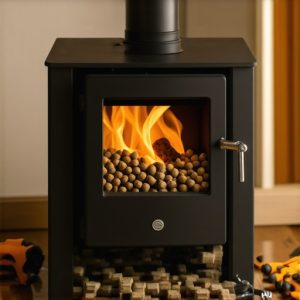
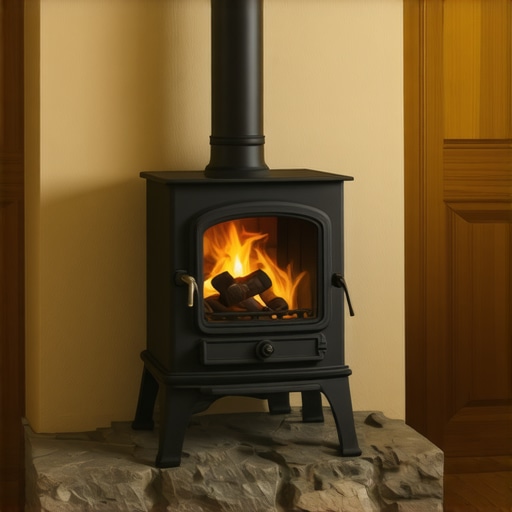
Let’s look at the mechanical anatomy of a wood stove setup. You’ve got the firebox (the heart), the flue (the throat), and the clearances (the lungs). If the lungs can’t breathe, the heart suffocates the house. Most unlisted stoves require a massive 36-inch clearance from any combustible surface. That’s three feet of dead space. Why? Because the air needs to circulate to carry away the sensible heat before it can sink into the drywall. If you’re tight on space, you use a heat shield. But here is where the ‘Sales Techs’ get it wrong: they think a piece of sheet metal screwed flat to the wall works. It doesn’t. You need a one-inch air gap behind that shield, held up by non-combustible spacers. That air gap creates a chimney effect, pulling cool air from the floor up behind the shield, stripping the heat away before it touches the wall. This is the same logic we use in heat exchanger cleaning—if the surface is fouled or blocked, the heat transfer goes where you don’t want it.
The Regulatory Reality: NFPA 211 and the 2025 Shift
We are entering a new era of regulation. Just as the HVAC world is reeling from the A2L refrigerant transition and the death of R-410A, wood stove codes are tightening. According to the NFPA 211 standards, there is no room for ‘close enough.’
“Clearance reduction systems shall be designed and installed such that the temperature of the combustible surface does not exceed 90°F (50°C) above the ambient temperature.” – NFPA 211: Standard for Chimneys, Fireplaces, Vents, and Solid Fuel-Burning Appliances
If you’re working on multi-family heating upgrades or even a school boiler maintenance project, you know that inspectors don’t care about your ‘Pookie’ (mastic) or how much tape you used to seal a leak; they care about the air gap. The same applies to your living room. If that wall hits 150°F, you’ve failed. When we perform industrial heater services, we use thermal imaging to find these hot spots. For a homeowner, you can use the ‘touch test’—though I wouldn’t recommend it if you value your skin. If the wall feels hot to the touch, your clearance is a joke.
Beyond the Stove: Integrating with Modern Systems
A wood stove shouldn’t be a lone wolf. In a properly engineered home, it works in tandem with your primary system. Maybe you have a two-stage furnace installation that handles the baseline load, and the wood stove provides that ‘bone-warming’ radiant heat during the peak of January. But you have to be careful about wiring repair for heating systems when you’re retrofitting these stoves. I’ve seen guys melt thermostat wires because they ran them through the same stud bay as the chimney pipe. It’s amateur hour out there. If you’re dealing with modern tech, like an occupancy sensor installation to save on energy, make sure the sensors aren’t pointed directly at the stove, or the infrared blast will trick the system into thinking the room is a crowded stadium.
The Maintenance Loop: Soot, Creosote, and Relays
Safety doesn’t end at the install. A wood stove is a dirty beast. Every season, you need to be looking at the flue just like we look at a heat exchanger. Soot acts as an insulator—but the bad kind. It traps heat in the pipe, leading to chimney fires. While we are on the subject of maintenance, don’t ignore the rest of your house. If you’re busy hauling logs, you might miss the fact that your furnace needs a relay services check-up. I always tell clients to read up on furnace repair myths debunked to ensure they aren’t neglecting their main heat source while playing lumberjack. And if you’ve got a guest room with a mini-split, check out this mini-split troubleshooting guide before the first frost hits. You don’t want to be troubleshooting a frozen coil when you’re also trying to manage a wood fire.
The Math of Survival: Cost vs. Risk
A proper wood burning stove installation with a professional hearth pad and shielded walls might cost you an extra $800 in materials and labor. A ‘budget’ install by a guy who usually just does relay services on the side might save you that money. But when the ‘Juice’ (electricity) goes out and you’re cranking that stove to keep the pipes from freezing, that $800 becomes the best insurance policy you ever bought. I’ve seen 30-year-old units that were installed with the right clearances still looking brand new. I’ve also seen brand new stoves melt the vinyl siding on the *outside* of the house because the ‘Sparky’ (electrician) who helped the homeowner didn’t understand thermal mass. If you’re unsure, contact us or a certified sweep. Don’t gamble with your family’s safety because you wanted to save a few bucks on a tin shield.