The Specific Signals That Put Your Repair Trucks at the Top of Google Maps
There is a specific kind of frustration reserved for the HVAC business owner who drives past a competitor’s truck parked in a driveway, only to realize that same competitor is hogging the #1 spot on Google Maps. You know your technicians are more qualified, your response times are faster, and your equipment is superior. Yet, when a homeowner searches for “emergency furnace repair,” your business is buried on page two, effectively invisible. For Service Area Businesses (SABs) that rely on repair trucks rather than a fancy downtown showroom, the struggle for google business profile seo is real. In 2026, the landscape has shifted. Ranking is no longer about who has been around the longest; it is about who provides the cleanest data and the strongest trust signals to Google’s increasingly sophisticated algorithm.
The Holy Trinity of Local Ranking: Relevance, Proximity, and Prominence
To understand why one repair truck ranks while another remains hidden, we must look at the three pillars of Google’s local search algorithm: Relevance, Proximity, and Prominence. These aren’t just buzzwords; they are the mathematical foundation of every local search result.
Relevance is the measure of how well your local listing matches what someone is searching for. If a user types in “leaky pipe repair” and your profile only mentions “general contracting,” Google won’t risk showing your business. You must be hyper-specific. This is why a comprehensive google business profile seo strategy is essential for repair-based businesses.
Proximity is the most literal factor. Google wants to show the closest solution to the user. However, for repair trucks, proximity is a double-edged sword. Since you are a Service Area Business, you don’t have a storefront for customers to visit. Google calculates your proximity based on the service areas you define and your “verified” home base. But here is the secret: proximity isn’t a “free win” anymore. If your prominence is low, Google will bypass a closer technician to show a more “prominent” one five miles further away.
Prominence is where the true separation happens between top-tier shops and the rest of the pack. Prominence is Google’s way of asking, “How famous is this business?” It is calculated through your review count, your star rating, the number of quality backlinks to your website, and mentions of your brand across the web. As Local SEO Consultant Kevin Pauls emphasizes, “The goal isn’t just visibility; it’s building enough trust for Google to recommend your trucks over a competitor’s.” If Google sees that your brand is frequently discussed and highly rated, it gains the “confidence” to put you at the top.
Before you can improve these pillars, you must ensure your foundation is solid. Many contractors fail because of simple oversights. If you aren’t seeing the results you expect, you should learn how to spot the profile errors costing your HVAC shop local customers.
Optimizing the “Service Area” for Repair Trucks
Unlike a coffee shop or a retail store, a repair business moves. Your “location” is wherever your trucks are currently parked. This creates a unique challenge for google business profile optimization. Many business owners make the mistake of selecting a massive 100-mile radius, thinking it will help them get more leads. In reality, this dilutes your local relevance signal.
Google favors businesses that demonstrate a dense, focused service area. Instead of claiming an entire state, select specific cities, counties, or zip codes where you actually have a physical presence or a high volume of jobs. This tells Google’s algorithm that you are a local authority in those specific zones. If you are struggling to show up in specific neighborhoods, you might need to adjust your strategy to rank higher on google maps by narrowing your focus rather than widening it.
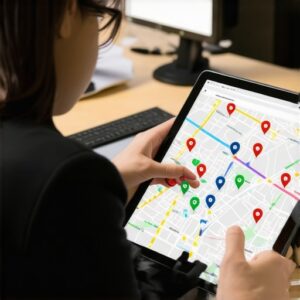
When setting up your service areas, avoid the temptation to “overpromise.” Google cross-references your service area with your website content and even the location data from your technicians’ mobile devices (if integrated). Using professional local seo tools can help you visualize where your current ranking “heat map” stands and where you need to bolster your presence. Remember, for a repair truck, your service area is your storefront. Treat it with the same precision you would a physical lease.
If you’re looking to expand your reach into more lucrative sectors, check out these 7 Google Maps Optimization Tips to Win More Commercial HVAC Contracts.
Category and Service Signals: Where Most Profiles Fail
One of the most common mistakes in google business profile seo is a “set it and forget it” approach to business categories. Your primary category is the single most important piece of metadata on your profile. For most repair businesses, “HVAC Contractor,” “Plumber,” or “Electrician” is the obvious choice. However, the real power lies in your secondary categories.
If you provide furnace repairs, AC installations, and duct cleaning, each of those must be represented. But don’t stop at categories. The “Services” section of your Google Business Profile (GBP) allows you to list specific offerings like “Heat Pump Installation,” “Emergency Boiler Repair,” or “Smart Thermostat Setup.” These act as “keywords” that help Google match your profile to long-tail searches.
Kevin Pauls often points out that “category fit” is a dynamic process. If it is mid-July, your “AC Repair” service should be front and center. If it is January, “Emergency Furnace Repair” needs to be your priority. This level of detail is what a high-quality google maps ranking service focuses on – ensuring that your profile isn’t just “active,” but contextually relevant to the current needs of the market.
To truly dominate, you need to know how to rank #1 on Google Maps for emergency furnace repairs without buying ads. It requires a surgical approach to these service signals.
The Review Velocity and Wording Pattern Signal
Every business owner knows reviews are important, but few understand the “signals” Google extracts from them. It isn’t just about having a 4.9-star rating. Google looks at Review Velocity – the consistency with which you receive new feedback. A business that got 50 reviews three years ago and nothing since is seen as “stale.” A business that gets 2-3 reviews every week is seen as “active” and “reliable.”
Furthermore, the wording within reviews is a massive ranking factor. When a customer writes, “The best furnace repair in Chicago, they fixed my heat pump in an hour,” they are doing your SEO for you. Those keywords – “furnace repair,” “Chicago,” and “heat pump” – are indexed by Google and tied directly to your profile’s relevance score. This is why encouraging customers to be specific in their reviews is a game-changer for local map pack seo.
You should also be responding to every single review. A response from the business owner signals to Google that the listing is managed and that the business is engaged with its clientele. This engagement is a “prominence” signal that helps you rank higher on google maps compared to a silent competitor.
Technical Signals: Local Landing Pages and Schema
Your Google Business Profile does not exist in a vacuum. It is tethered to your website. If your GBP says you serve “Springfield,” but your website never mentions “Springfield,” Google sees a disconnect. This is where “City Pages” or “Service Area Pages” become vital. These pages should be optimized with local content, testimonials from that specific area, and technical markers like Local Business Schema.
Local Business Schema is a snippet of code that tells search engines exactly what your business is, where it is, and what it does in a language they can’t misunderstand. It bridges the gap between your website and your map listing. As many experts agree, why local schema markup is the secret to winning local HVAC search is because it removes the “guesswork” for the AI-driven algorithms of 2026.
If your website is poorly structured, your GBP will suffer. If you find that your traffic isn’t converting, it might be time to investigate why your city pages aren’t turning local searchers into heat pump leads. A cohesive strategy ensures that the signal sent from your website reinforces the signals sent from your Google Business Profile.
2026 Trends: AI Overviews and Behavioral Signals
The world of search is changing rapidly. According to Datos research (January 2026), 37% of consumers now start searches with AI or AI-integrated assistants rather than traditional search bars. These AI models don’t just look for keywords; they look for “clean data” and “authoritative proof.” If your NAP (Name, Address, Phone Number) is inconsistent across the web, an AI assistant won’t recommend you because it can’t be 100% sure of your details.
Furthermore, Google is placing more weight on Behavioral Signals. These are actions taken by users that prove your listing is useful. These include:
- Clicks to Website: Does the user want to learn more?
- Click-to-Call: Is the user ready to book a repair?
- Driving Directions: Even for SABs, people sometimes look at your “base” to see how far away you are.
If 100 people see your listing but only 1 clicks “Call,” Google assumes your listing isn’t what people are looking for and will lower your rank. This is why having high-quality photos of your branded trucks, your friendly technicians, and your completed work is essential. These visual cues drive the clicks that tell Google you are the top choice in the area. Utilizing a specialized gmb ranking service can help optimize these conversion-heavy elements of your profile.
Conclusion: Moving Your Trucks to the Top
Dominating the local map pack isn’t the result of one single “hack.” It is the culmination of dozens of specific signals – relevance, proximity, prominence, review velocity, and technical schema – all working in harmony. For repair truck businesses, the stakes are high. Being the first name a homeowner sees during a plumbing or HVAC emergency can mean the difference between a thriving fleet and a struggling shop.
Local SEO is an ongoing process of refinement and adaptation. As the algorithm evolves and AI search becomes the norm, staying ahead of the curve is mandatory. Whether you choose to manage this yourself using SEO Viper Tools or hire a professional google maps ranking service, the time to act is now. Audit your profile, clean up your data, and start sending the signals that put your trucks at the top of the map.