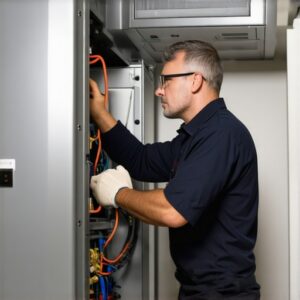
The sound of a furnace failing isn’t always a bang; sometimes it is a whisper, a faint whistle, or the absolute silence of a pilot light that refuses to stay lit. In my thirty years of crawling through spider-infested crawlspaces and balancing on joists in freezing attics, I have learned that a furnace is a controlled explosion held captive in a metal box. When that box gets old, the control starts to slip. Most folks think a furnace tune-up is just a guy with a shop vac sucking out some dust. If that is what your tech is doing, you are being robbed. Real furnace maintenance is about the chemistry of combustion and the metallurgy of the heat exchanger.
The Anatomy of a Near-Miss: A Forensic Case Study
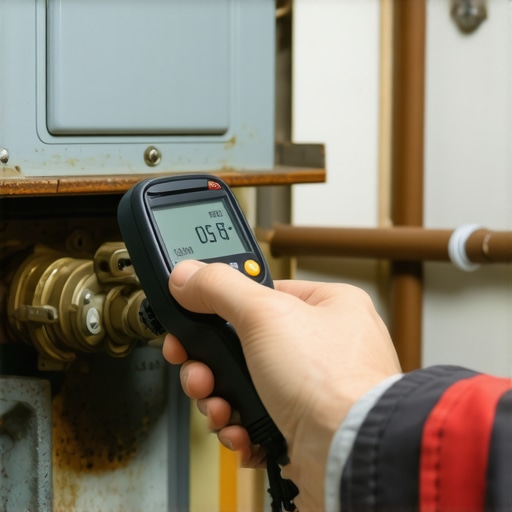
I remember following a ‘Sales Tech’—those guys who wear crisp white shirts and carry iPads but wouldn’t know a thermocouple from a toasted marshmallow—to a job in a drafty Victorian home. He had quoted the homeowner, a retired schoolteacher, a staggering $22,000 for a full boiler and furnace replacement, claiming her unit was ‘leaking raw gas’ and would explode by morning. I arrived for a second opinion. I pulled out my electronic leak detector and my soapy bubble solution. It turned out the ‘gas leak’ was a tiny weep at a flare fitting that needed a quarter-turn with a wrench. The tech hadn’t even checked the heat exchanger for cracks; he just saw a gray hair and a big commission. That is why I tell people: you don’t need a salesman; you need a technician who understands combustion analysis and the physical limits of cold-rolled steel.
“The most expensive equipment in the world cannot overcome a bad duct system.” – Industry Axiom
The Physics of the Heat Exchanger: Why Old Steel Fails
To understand why we insist on annual gas leak checks, you have to understand Thermodynamic Zooming. Inside your furnace, the burner ignites gas, creating a flame that reaches upwards of 3,000°F. This heat is transferred through the metal walls of the heat exchanger. On the other side, your blower motor pushes cold house air over that hot metal. This is where the magic happens: the air picks up the heat, and the toxic combustion byproducts (like Carbon Monoxide) are vented outside. But think about the stress on that metal. Every time the heat kicks on, the metal expands. When it shuts off, it contracts. After twenty years of this ‘breathing,’ the steel gets brittle. It develops micro-fissures. When those fissures open up, the ‘gas’ isn’t just fuel; it’s the invisible, odorless byproduct of incomplete combustion leaking into your bedroom. This is why furnace repair myths can be so dangerous; ignoring a small smell could be a fatal mistake.
Combustion Analysis: More Than Just a Blue Flame
A lot of ‘Tin Knockers’—the guys who just install ductwork—think a blue flame means everything is fine. That’s bush-league thinking. I use a digital combustion analyzer to measure the parts per million (PPM) of Carbon Monoxide in the flue and the oxygen levels. If the O2 is too high, the flame is ‘lean’ and potentially blowing itself out. If it’s too low, it’s ‘rich’ and producing soot that clogs the system and creates a fire hazard. For those with a modulating furnace repair need, this becomes even more complex because the gas valve and inducer motor change speeds to match the heating load. It’s not just an on-off switch anymore; it’s a high-performance engine that requires precise tuning. If you aren’t getting furnace tune-up services that include a manifold pressure check, you aren’t getting a real service.
The North/Cold Climate Reality: Why We Can’t Wait
Up here in the cold zones, your furnace isn’t a luxury; it’s life support. When the polar vortex hits and your unit is running 20 hours a day, any weakness in the wiring repair for heating systems will reveal itself. I have seen app-controlled heating systems fail not because of the software, but because a Sparky (electrician) didn’t ground the low-voltage side properly, causing the control board to fry when the furnace tried to ramp up. We also see major issues with boiler maintenance services where the expansion tank loses its pre-charge, causing the pressure relief valve to weep gas and water. If you are looking for remote thermostat access, make sure your system is robust enough to handle the communication; otherwise, you’ll be staring at a ‘system offline’ message while your pipes freeze.
“Unvented or improperly vented gas appliances pose a significant risk of carbon monoxide poisoning.” – NFPA 54 Regulations
Modern Solutions: From Ductless to Dehumidification
Sometimes the old furnace is just too far gone. If the heat exchanger is cracked, I don’t care how much Pookie (mastic) or foil tape you have; the unit is a paperweight. In those cases, we look at ductless mini-split installation for hard-to-heat rooms or dehumidification services to handle the latent heat loads that occur during the shoulder seasons. If you’re on a HVAC maintenance plan, these transitions aren’t a surprise; they are planned upgrades. Whether it is wiring repair for heating systems or installing a new high-efficiency unit, the goal is always the same: keep the fire in the box and the heat in the house. If you suspect a leak or just haven’t had your heat exchanger scoped in a year, it’s time to contact us for a real inspection. Don’t let a ‘Sales Tech’ scare you, but don’t let a cracked furnace kill you. Check the hvac repair secrets we’ve compiled to see what a real pro looks for during a visit.