The Sound of a Blower That Won’t Quit: A Forensic Diagnosis
It is 3:00 AM in the middle of a January cold snap. The wind is rattling the siding, and you are staring at the ceiling because there is a low-frequency hum vibrating through the floorboards. It is the sound of your furnace blower motor. It has been running for three hours straight, but the house is actually starting to feel colder. You check the thermostat; it is set to 70°F, and the display says it is 68°F. The air coming out of the vents is lukewarm at best. You are witnessing a classic HVAC failure, but before you call a Sparky or a Tin Knocker to rip your ductwork apart, you need to understand the physics of what is happening inside that cabinet.
My old mentor, a man who had more soot in his lungs than a Victorian chimney sweep, used to scream at me, ‘You can’t heat what you can’t touch!’ He was talking about the boundary layer of air on a heat exchanger, but the logic applies to your blower motor too. If that fan is spinning but the burners aren’t firing, you are just circulating cold air, turning your home into a giant convection oven set to ‘defrost.’ Most homeowners think a fan that won’t stop is a ‘bonus’ because they are getting ‘circulation,’ but in reality, you are killing your motor bearings and skyrocketing your electric bill.
“The most expensive equipment in the world cannot overcome a bad duct system.” – Industry Axiom
The Hierarchy of Why: From Simple Fixes to Forensic Failures
Let’s start with the most embarrassing fix first: The Thermostat Fan Switch. Look at your thermostat right now. Is the fan setting on ‘ON’ or ‘AUTO’? If it is on ‘ON,’ the blower will run until the heat death of the universe, regardless of whether the furnace is actually heating. Flip it to ‘AUTO.’ If the fan stops within two minutes, congratulations, you just saved a $150 service call. If it keeps spinning, we have to go deeper into the guts of the machine.
In northern climates like Chicago or the Northeast, we deal with extreme temperature differentials. When it is -10°F outside, your furnace is under immense stress. A common culprit for a runaway fan is a tripped limit switch. The limit switch is a safety device designed to shut off the gas but keep the fan running if the furnace gets too hot (to prevent the heat exchanger from cracking). If your filter is clogged with three years of cat hair and dust, the airflow drops, the temperature inside the cabinet spikes, and the limit switch ‘opens.’ The board sees this as an emergency and keeps the fan on to cool the system down. If the switch fails in the open position, the fan stays on forever.
The Anatomy of the Heat Cycle: Why Airflow is King
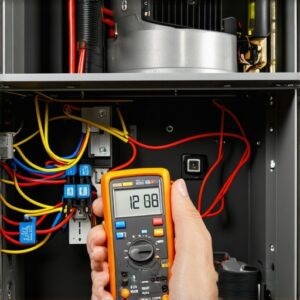
When we perform HVAC load calculation services, we aren’t just guessing based on square footage. We are looking at the cubic feet per minute (CFM) required to move heat effectively. If your furnace fan won’t stop, it might be because the system is struggling to reach the setpoint. This is where furnace tune-up services become critical. During a tune-up, we don’t just vacuum the floor; we check the static pressure. High static pressure is like trying to breathe through a cocktail straw while running a marathon. It wears out the blower relay on the control board, often welding the contacts together so the fan stays energized constantly.
Another common issue is a dirty flame sensor. If your furnace starts, runs for 10 seconds, shuts off the flame, but keeps the fan running, you likely need furnace flame sensor cleaning. The sensor is a simple rod of Kanthal metal that uses the flame to complete a DC microamp circuit (flame rectification). If it is covered in carbon or oxidation, the board thinks the furnace failed to light and keeps the blower on to purge the chamber of unburnt gas. You can find more about this in our
The Thermodynamic Reality of Modern Systems
If you are still using an old standing pilot furnace, you might be dealing with a pilot light relighting issue, but most modern systems are electronic. In multi-family environments, we often see multi-family heating upgrades where individual units are replaced with high-efficiency furnaces. These units have complex control boards that are sensitive to power surges. If a relay on the board ‘sticks,’ the blower stays on. This is usually the ‘Simple Fix’—replacing the board—but it’s a $500 ‘simple’ fix.
We also have to talk about the transition to 2025 regulations. As we move away from certain refrigerants, many homeowners are looking at heat pump replacement options. A heat pump’s fan logic is different; it often runs longer at lower speeds to manage latent heat (humidity). However, if your gas furnace fan is acting up, it is a sign of a mechanical or electrical mismatch. If you’ve recently had a gas line installation for furnaces, a technician might have bumped the wiring or set the ‘fan off’ delay too high on the DIP switches of the control board.
“Proper furnace installation requires a comprehensive HVAC load calculation to ensure the heat exchanger operates within its designed temperature rise.” – ACCA Manual S
When to Call the Pros and When to DIY
If you’ve checked the thermostat and the filter, and the fan is still screaming, it’s time to look at the limit switch or the control board. Do not attempt to bypass a limit switch. I’ve seen ‘handymen’ jump out a limit switch only to have the heat exchanger crack and leak carbon monoxide into the house. It’s not worth it. If you are dealing with other issues like a hot water heater repair or even a pool heater repair, it is often best to bundle these services during a winter maintenance visit. Many utility companies offer rebate application assistance for high-efficiency upgrades, which can offset the cost of a full system replacement if your old furnace is a money pit.
For those with ductless systems, check out our
Remember, HVAC isn’t magic; it’s physics. Every BTU has to go somewhere, and every amp has a reason for flowing. If your fan won’t stop, it’s because the system thinks it’s still doing a job that it likely finished an hour ago. Put down the hammer, stop guessing, and look at the sequence of operations. For more deep dives into saving your equipment, read our