The Acrid Scent of a Breaker on the Brink
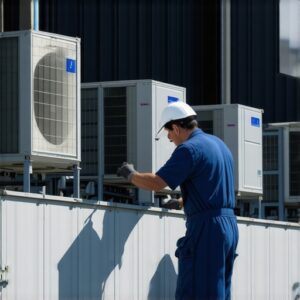
You know that smell. It is not the sweet, slightly oily scent of fresh refrigeration juice or the metallic tang of a new tin knocker’s ductwork. It is the acrid, ozone-heavy stench of a 15-amp circuit breaker screaming for mercy while a 1500-watt ceramic heater fights a losing battle against a drafty office window. I have spent thirty years crawling through crawlspaces and balancing on ice-slicked rooftops, and if there is one thing I have learned, it is that a portable heater is rarely a solution; it is a confession of a failing HVAC system. When I see a sea of space heaters in a commercial building, I do not see ‘comfort’—I see a building where the school boiler maintenance was ignored or where the warehouse heating solutions were designed by someone who thinks thermodynamics is a suggestion rather than a law of physics.
The Physics of the Cold Spot: Why Your Desk is Freezing
My old mentor used to scream, ‘A space heater is just a bandage for a hemorrhaging duct system!’ This was his way of saying that if you cannot get the air to the desk, the horsepower of the unit does not matter. Most office ‘cold spots’ are the result of poor static pressure. When a building’s MERV filter upgrades are done without accounting for the increased resistance, the blower motor cannot push enough CFM (cubic feet per minute) to reach the end of the run. The air loses its velocity, drops out of the sky, and leaves the person at the far desk shivering. Instead of fixing the airflow, the facility manager lets the employee plug in a resistive heater. This is a thermodynamic disaster. A standard portable heater uses resistive heating—electrons fighting their way through high-resistance nichrome wire. It is 100% efficient at turning electricity into heat, which sounds great until you realize a modern heat pump has a COP (Coefficient of Performance) of 3.0 or higher, meaning it is 300% efficient by moving heat rather than creating it.
“The most expensive equipment in the world cannot overcome a bad duct system.” – Industry Axiom
The Forensic Diagnosis: Anatomy of a Workplace Fire Hazard
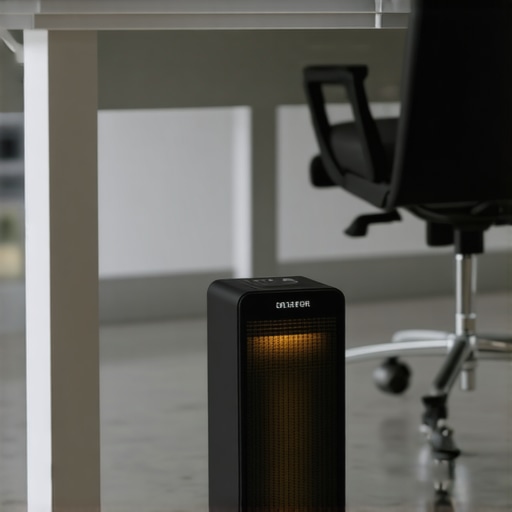
Let’s talk about the ‘Sparky’s’ nightmare. A standard office outlet is rated for 15 amps. A 1500-watt heater pulls about 12.5 amps. Now, add a computer, two monitors, and a desk lamp to that same circuit. You are redlining the copper. I have seen ‘Sales Techs’ try to sell a whole new multi-split system when the real issue was just a dead thermocouple replacement in the main boiler or a stuck damper. They want the commission; I want your building to not burn down. If you are going to use these ‘heat-boxes,’ you need to understand the physics of sensible heat. These units provide localized radiant or convective heat, but they do nothing for the building’s envelope. In fact, they can trick your thermostat into thinking the room is warm, causing the actual HVAC system to shut down and leaving the rest of the office in a polar vortex. If your office feels like a meat locker, it is time to look at hvac repair secrets rather than buying another fire hazard from a big-box store.
The Regulatory Reality and the 2025 Shift
We are entering a new era of HVAC. With the death of R-410A and the transition to A2L refrigerants like R-454B, the cost of emergency repairs is going to skyrocket. This makes predictive maintenance alerts more than just a luxury—they are a financial survival tool. In a school or warehouse setting, ignoring a small vibration in a blower or a slight drop in suction line pressure (what we call ‘beer can cold’ when it’s right) means you will be face-to-face with a $15,000 replacement bill next July. We are also seeing a massive push for solar thermal heating integration and mini-split installations to replace aging, inefficient central plants. A mini-split is essentially a localized heat pump that is infinitely safer and more efficient than any portable heater. It uses an inverter-driven compressor to modulate the ‘gas’ flow, providing exactly the BTUs needed without the ‘all-or-nothing’ waste of a resistive coil.
“Unvented combustion heaters shall not be used as a primary source of heat in any occupied space.” – ASHRAE Standard 62.1
Infrared vs. Convection: The Warehouse Struggle
In large open spaces, traditional forced air is a joke. You are trying to heat 50,000 square feet of air to keep three people warm. This is where infrared heater installation becomes the hero. Unlike convection heaters that warm the air (which then immediately rises to the ceiling where the spiders enjoy it), infrared waves travel through the air and heat the objects—the people, the floor, the desks. It is the same physics as standing in the sun on a cold day. If your warehouse staff is huddling around portable ceramic units, your warehouse heating solutions have failed. You are literally burning money. Proper spa heater services for specialized commercial equipment follow the same logic: focus the energy where it’s needed, don’t just blast it into the void.
The Safety Checklist for the Desk-Bound
If you absolutely must allow portable heaters, here are the non-negotiable rules from a guy who has seen the aftermath of the alternative. 1. The 3-Foot Rule: Nothing flammable within 36 inches. No ‘Pookie’ (mastic), no paper, no curtains. 2. Direct Plug-In Only: Never, ever use a power strip. The contact points in a cheap strip cannot handle the continuous load of a heater. 3. Tip-Over Protection: If it doesn’t have a kill-switch on the bottom, it’s a paperweight. 4. Auto-Shutoff Timers: Because ‘Sparky’ doesn’t want to come out at 3 AM when the cleaning crew leaves it on. If your system is so broken that these rules are being ignored daily, you should check our ultimate guide to heat pump maintenance to see what a real fix looks like. Don’t let a ‘Sales Tech’ talk you into a $20,000 system when a simple airflow balancing or a mini-split troubleshooting session could solve the problem. Comfort is a matter of physics and proper maintenance, not just cranking up a localized toaster under your desk. Check our privacy policy for how we handle your data when you reach out for a real diagnosis via our contact page. Remember, a warm office is a productive one, but a burnt-down office is a bit of a career-stopper. Stop debunking furnace repair myths on your own and call someone who knows the difference between a capacitor and a contactor. [{“@context”:”https://schema.org”,”@type”:”HowTo”,”name”:”Safe Office Portable Heater Usage”,”step”:[{“@type”:”HowToStep”,”text”:”Ensure the heater is plugged directly into a wall outlet, never a power strip.”},{“@type”:”HowToStep”,”text”:”Maintain a three-foot clearance from all combustible materials.”},{“@type”:”HowToStep”,”text”:”Verify the unit has an automatic tip-over shutoff switch.”}]}]