The Whistle of a Dying System
You hear it before you see it. That high-pitched, harmonic whine coming from the return air grille. Most homeowners ignore it, thinking it’s just the sound of ‘the wind’ in the house. To me, after thirty years of hauling manifolds through crawlspaces, that sound is a scream for help. It’s the sound of a blower motor fighting for its life against a duct system that’s basically a clogged artery. When we talk about 2026 standards and the push for AI-driven HVAC optimization, everyone wants to talk about smart chips and sensors. But as a tech who’s seen more fried control boards than I care to count, I’m here to tell you that all the silicon in the world won’t save a compressor that can’t breathe. We are entering an era where the margin for error is zero. If your static pressure is off, your expensive new variable-speed unit is just a very heavy, very expensive paperweight.
The Physics Lesson: You Can’t Cool What You Can’t Touch
My old mentor, a man who could sniff out a refrigerant leak from the curb, used to stand over me while I was trying to balance a multi-zone system in a freezing warehouse. He’d wait until I was sweating, then he’d bark, ‘Kid, you can’t cool what you can’t touch!’ It was his way of drilling in the fundamental law of thermodynamics: heat transfer requires mass flow. If the air isn’t physically moving across the evaporator coil, the ‘juice’ (that’s refrigerant for the laypeople) can’t pick up the heat. You can have the most advanced thermostat installation in the county, but if the ductwork is undersized, the physics simply won’t work. We call this Total External Static Pressure (TESP), and it is the ‘blood pressure’ of your HVAC system. When it’s high, the heart—your blower motor—works harder, runs hotter, and eventually strokes out.
“Duct systems shall be sized according to ACCA Manual D, and the total external static pressure shall not exceed the manufacturer’s fan curve limits.” – ACCA Manual D Standard
In the cold climates of the Northeast and Midwest, where we deal with everything from hotel boiler services to radiant floor heating installation, the airflow issue is even more critical. During a polar vortex, your furnace isn’t just a luxury; it’s a life-support system. If you’ve invested in new construction heating design, the ‘Tin Knockers’ (the sheet metal experts) need to be your best friends. They are the ones who ensure that the plenums aren’t restricted and that every branch run has a balancing damper. Without that baseline, even the best IAQ improvement services will fail because the air won’t move through the high-efficiency filters you just paid a premium for.
The Filter Trap and the IAQ Paradox
Let’s talk about furnace filter replacement. This is where most homeowners unknowingly sabotage their own comfort. You go to the big-box store and buy the MERV 13 ‘Allergy Destroyer’ filter because you want clean air. That’s noble. But that thick, pleated filter is like trying to run a marathon while breathing through a cocktail straw. If your return ducting wasn’t designed for that level of restriction, your static pressure shoots through the roof. The blower slows down, the coil gets too cold, and suddenly you’re looking at a block of ice where your coil used to be. For more on how to avoid these common pitfalls, check out these hvac repair secrets to boost efficiency. I’ve seen brand-new wall furnace installation projects fail in six months because the owner didn’t understand that airflow is a balance, not a brute force competition. In 2026, we’ll see more systems integrated with sensors that will literally shut the unit down if the filter is too dirty, protecting the equipment from the ‘Sales Techs’ who just want to sell you a new motor every two years.
The Mechanical Anatomy: Why 0.5 is the Magic Number
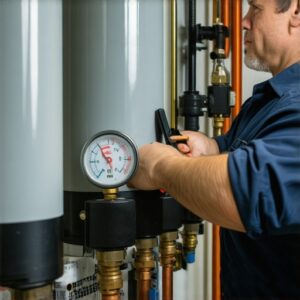
When I hook up my dual-port manometer to a system, I’m looking for a specific number: 0.5 inches of water column. That is the industry standard for most residential blowers. If I see 0.9 or 1.1, I know we have a problem. It could be a ‘pookie’ (mastic) disaster where someone used too much sealant inside a joint, or more likely, it’s a flex duct that’s been crushed in the attic. High static pressure doesn’t just kill motors; it ruins the ‘beer can cold’ suction line feel we look for in the summer. It leads to pilot light relighting issues in older furnaces because the pressure switches won’t close, and it makes ventless gas heater services a nightmare when the oxygen depletion sensors start tripping due to poor room-to-room air exchange.
“The most expensive equipment in the world cannot overcome a bad duct system.” – Industry Axiom
If you’re dealing with a system that feels sluggish, don’t just ask for more ‘gas.’ Ask for a static pressure test. A real tech will pull out a drill, make two small holes (and plug them afterward), and give you the data. If they don’t have a manometer, they aren’t a tech; they’re a part-changer. For those struggling with more complex setups, like multi-stage units, I recommend reading the mini split troubleshooting guide to understand how different technologies handle air distribution. Whether it’s a hotel boiler or a residential split system, the math remains the same: CFM (Cubic Feet per Minute) is the king of the mountain.
The Future: AI and the 2026 Standards
We are moving toward a world where AI-driven HVAC optimization will constantly monitor static pressure in real-time. Imagine a system that alerts your phone not just when the filter is dirty, but when a duct has slipped off in the crawlspace, causing a massive pressure drop. This isn’t science fiction; it’s the 2026 reality. We are seeing new construction heating design incorporate these ‘smart’ ducts. But until that’s standard, you need to rely on the fundamentals. If you’re planning a wall furnace installation or upgrading your thermostat, ensure the professional you hire understands the load calculations. Many furnace repair myths revolve around the idea that ‘bigger is better.’ In reality, an oversized unit on undersized ducts is a recipe for a short-lived compressor and a very high electric bill. Comfort is physics, and physics doesn’t care about your marketing brochures.