The Anatomy of a Silent Furnace: When the Purple Fuse Dies
There is a specific, haunting silence that follows a 3-amp fuse popping on a furnace control board. It’s not just the lack of heat; it’s the sound of a safety system doing its job while your family starts looking for the heavy blankets. I’ve spent three decades in the frozen attics of the Northeast, and I can tell you this: a fuse doesn’t just ‘wear out.’ It’s a sacrificial lamb. If it’s blowing every time the thermostat calls for heat, you don’t have a fuse problem; you have a physics problem. My old mentor, a man who could sniff out a cracked heat exchanger from the driveway, used to scream, ‘You can’t cool or heat what you can’t touch!’ This was his way of saying airflow and electrical continuity are the only two things that matter. If the ‘Sparky’ didn’t wire it right, or the ‘Tin Knocker’ didn’t size the return, the furnace is going to fight itself until something breaks.
“The most expensive equipment in the world cannot overcome a bad duct system or improper electrical load balancing.” – Industry Axiom
The Forensic Breakdown: Why the Short Happens
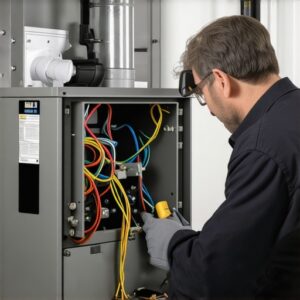
When a furnace blows a fuse the moment the cycle starts, we look at the 24-volt circuit. This is the nervous system of your HVAC. If you’ve recently tried a DIY thermostat installation, that’s the first place I’m looking. A common mistake is pinching a wire behind the sub-base, creating a direct path to ground. But if you haven’t touched the thermostat, we move to the ‘Low Voltage Ghost.’ This is often a wire in the condenser outside (if you have a heat pump or AC combo) that a weed-whacker or a rodent has chewed through. The moment the furnace tries to send ‘the juice’ to the contactor, it hits the frame, and pop—there goes your fuse. This is why wiring repair for heating systems isn’t just about twisting caps; it’s about tracing the path of least resistance. For those with older setups, steam boiler repair involves similar electrical logic regarding low-water cutoffs, but in a forced-air furnace, the culprit is usually more mechanical.
The Limit Switch and the Airflow Manifesto
Let’s talk about limit switch replacement. Homeowners often think the limit switch is broken because it keeps tripping. Usually, the switch is fine—it’s actually saving your life. If your furnace is overheating because you haven’t performed MERV filter upgrades correctly, the internal temperature skyrockets. A MERV 16 filter in a system designed for a MERV 4 is like trying to breathe through a piece of plywood. The lack of airflow causes the heat exchanger to expand too far, potentially cracking it. This leads us to the critical need for a combustion analysis. If your furnace is blowing fuses, it might be the inducer motor drawing too many amps because the bearings are screaming like a banshee. This motor clears the flue gases; if it fails, the system stays off to prevent carbon monoxide from entering your bedroom. Unlike evaporative cooler services where moisture is the main concern, furnace diagnostics are a battle against fire and electricity.
“Equipment shall be sized according to the heating and cooling loads calculated in accordance with ACCA Manual J.” – ASHRAE Standards
Beyond the Furnace: Heat Pumps and Pool Heaters
If you are running a hybrid system, you should check our ultimate guide to heat pump maintenance and repairs. Often, a short in the defrost board of the outdoor unit will blow the indoor furnace fuse. It’s all connected. Even a pool heater repair can offer lessons here—water and electricity are a bad mix, but in a furnace, it’s vibration and heat that rub the insulation off wires. If your system is old, you might be falling for common traps; read up on furnace repair myths debunked to ensure you aren’t being sold a new unit when you just need a $50 wire repair. While you’re waiting for a pro, avoid the temptation of space heaters without performing portable heater safety checks—I’ve seen more house fires from those ‘little boxes’ than from actual furnaces.
The Solution: HVAC Maintenance Plans
Stop playing ‘Parts Roulette.’ Replacing the fuse over and over is like putting a band-aid on a gunshot wound. Professional HVAC maintenance plans include checking the amp draw of your blower motor and the resistance of your igniter (the ‘glow-coil’). If your igniter is cracked, it can short out and kill the board. For complex setups like ductless units, see our mini split troubleshooting guide. Whether it’s a simple fix or a total overhaul, understanding the hvac repair secrets that pros use can save you thousands. If the fuse keeps blowing, it’s time to contact us or a licensed tech to find that short before it turns into a fire. Remember: heat is a luxury, but safety is a requirement. Don’t let a $3 fuse lead to a $15,000 disaster.”