I remember walking into a basement in the dead of a January freeze, the kind of cold that makes the siding on a house groan. The homeowner, a self-proclaimed ‘handyman’ who spent too much time on YouTube, was standing next to a cast-iron boiler with a wrench in one hand and a look of pure terror on his face. He’d tried to convert his natural gas boiler to propane himself because he’d heard propane was ‘hotter.’ He wasn’t wrong about the heat, but he was dead wrong about the physics. I could smell the odorant—that cloying, rotten-egg stench of ethyl mercaptan—pooling around my boots. Propane is heavier than air; it doesn’t just float away like natural gas. It sits. It waits for a spark from a water heater pilot or a light switch. I followed a ‘Sales Tech’ earlier that week who had quoted this man $22,000 for a total system replacement, claiming the unit was ‘compromised.’ All the unit actually needed was the correct manifold pressure and the right sized orifices, not a death sentence from a guy in a polished polo shirt looking for a commission. I spent thirty minutes fixing the ‘DIY’ disaster and another hour lecturing him on why playing with gas pressures is a fast track to a Darwin Award.
The Physics of the ‘Juice’: Why Propane Isn’t Just ‘Different Gas’
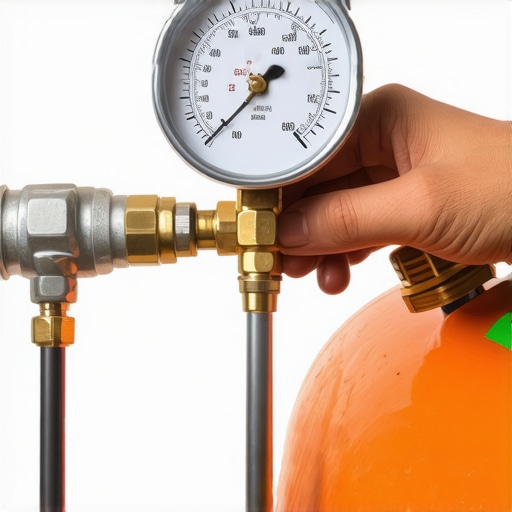
When we talk about HVAC repair and fuel conversion, we aren’t just swapping parts; we are recalibrating a combustion event. Natural gas arrives at your house at a relatively low pressure, usually around 7 inches of water column. Propane, or the ‘gas’ as we call it in the field, is delivered as a liquid and regulated down to 11 inches of water column for most residential equipment. If you don’t change the springs in the regulator and the orifices in the burners, you’re either going to starve the flame or create a blowtorch effect that will crack a heat exchanger in forty-eight hours. This is especially critical in church heating systems where the scale of the equipment means a mistake isn’t just a leak—it’s a catastrophic failure of a massive mechanical footprint. You have to understand the stoichiometric ratio. Propane requires significantly more air for complete combustion than natural gas. Without a tin knocker or a certified tech ensuring the duct design services provide enough secondary air, you’re looking at incomplete combustion, which produces carbon monoxide—the silent killer I’ve seen nearly take out entire families because they wanted to save a few bucks on a conversion kit.
“The installation of gas-burning appliances must conform with local codes or, in the absence of local codes, with the National Fuel Gas Code, ANSI Z223.1/NFPA 54.” – NFPA 54 Standard
The Regulator Trap and the Two-Stage Furnace
Modern two-stage furnace installation requires a level of precision that a DIYer simply cannot achieve without a calibrated manometer. We aren’t just looking for ‘a flame.’ We are looking for a specific manifold pressure for the low-fire stage and a different one for the high-fire stage. If the propane conversion isn’t dialed in, the transition between these stages will cause the burners to ‘chug’ or ‘roll out,’ which trips the limit switches and leaves you in the dark. It’s the same logic for a garage heater installation. People think because it’s ‘just the garage,’ they can slap a heater on the wall and run a rubber hose. I’ve seen more scorched rafters from improperly vented garage heaters than I care to count. Whether it’s boiler repair services or a new heat pump replacement, the thermodynamics don’t care about your budget. If you are moving from a standard furnace to a high-efficiency propane setup, you also have to consider the condensate. Propane combustion produces water vapor as a byproduct. In a high-efficiency system, that water is acidic. If you don’t have the proper neutralizer and drainage, that ‘liquid gold’ will eat through your floor drains and concrete before the first season is over.
Airflow is King: The Latent Heat Factor
You can have the most expensive propane-fired boiler in the county, but if your duct design services are garbage, you’re just burning money. I always tell my apprentices: ‘You can’t heat what you can’t touch.’ Airflow is the vehicle that carries the BTU. In the North, where we deal with brutal winters, energy recovery ventilators (ERVs) are becoming mandatory for a reason. As we seal houses tighter to save on propane costs, we trap moisture and pollutants. The ERV allows us to swap stale indoor air for fresh outdoor air without losing the sensible heat we just paid to produce. If you’re considering a ductless mini-split installation as a supplement to your propane heat, you’re thinking like a pro. Those units handle the ‘shoulder seasons’ (spring and fall) perfectly, allowing your heavy-duty propane system to stay dormant until the real ‘Polar Vortex’ hits. But even then, if the static pressure in your main system is too high because of a ‘Pookie’ (mastic) job done poorly or a DIY duct hack, your blower motor will scream itself to death. Understanding the balance between latent heat removal and sensible heat gain is what separates a Master Tech from a parts changer. If you’re struggling with a system that just won’t stay running, you might want to read about furnace repair myths debunked before you let a ‘Sales Tech’ talk you into a $15,000 mistake.
“Unrestricted airflow is the fundamental requirement for all thermodynamic exchange within a residential HVAC circuit.” – ACCA Manual D
The 2025 Regulatory Cliff: R-454B and Propane Safety
We are currently facing the biggest shift in HVAC history with the phase-out of R-410A refrigerant and the move toward A2L refrigerants like R-454B. Why does this matter for your propane conversion? Because the new systems are being built with sensors and safety protocols that are more sensitive than ever. If you have a heat pump replacement paired with a propane ‘dual-fuel’ backup, the integration between the two must be seamless. A DIY conversion can send the wrong signals to the control board, leading to frequent lockouts. If you’ve noticed your system acting up, check out this guide on mini-split troubleshooting to see if your issues are electronic or mechanical. For those in drier climates using evaporative cooler services, the transition to propane heat in the winter requires a total isolation of the cooling system to prevent the propane furnace from pulling in damp, outside air that will rust out the heat exchanger in a single season. This isn’t just ‘repairing’ things; it’s protecting an investment. Dealing with high head pressures or acidic combustion byproducts isn’t a weekend project. It requires a Sparky for the wiring and a licensed gas fitter for the ‘juice.’ Don’t be the guy I found in that freezing basement. Protect your home and your family by hiring someone who knows the difference between a 1/2-inch gas line and a potential pipe bomb. If you need a professional look at your system, you know where to contact us. We also recommend reviewing our HVAC repair secrets to stay ahead of the curve. And as always, your data is safe with our privacy policy.